



Bridgeland Realtor — Your Local Guide to Bridgeland, Cypress TX 77433
I’m Kevan Pewitt, a Bridgeland real estate agent and REALTOR®, and the broker-owner of Houston Prime Realty. Bridgeland is one of the largest master-planned communities in the Houston area — about 11,500 acres of Cypress prairie that Howard Hughes Holdings has been turning into neighborhoods, lakes, and a town center since 2006. It sits roughly 30 miles northwest of Downtown, with the Grand Parkway running right through the middle, and it’s defined by water and green space: 3,000+ acres of it, with stocked lakes, 74 parks, and trails between the villages.
Bridgeland at a glance
| Location | Cypress, NW Houston — about 35–45 min to Downtown via US-290 |
| Community type | Master-planned, ~11,500 acres — four villages plus Bridgeland Central |
| Median price | ~$519,000–$529,000 (about $197/sq ft), Sept 2026 (HAR MLS, 90-day) |
| Price range | Low $300s to about $1.9M |
| Property tax | ~2.8% in established sections, over 3% in the newest — varies by MUD and section |
| HOA dues | ~$1,300–$1,400 per year |
| Seller resale fee | 0.5% conveyance fee + ~$250 transfer, paid by the seller at closing |
| Schools | Cy-Fair ISD (east villages) / Waller ISD (west villages) — verify by address |
| New construction | Yes — Creekland, Prairieland, and Bridgeland Central |
| Flood | Engineered lakes and detention; confirm the FEMA designation per lot |
| Best for | Amenity-rich, nature-focused suburban living with new-construction options and quick Grand Parkway access — weighing higher tax and HOA costs and an ongoing build-out |
Figures are point-in-time and vary by section and address — verify before relying. Not legal or tax advice.
Where Bridgeland is located
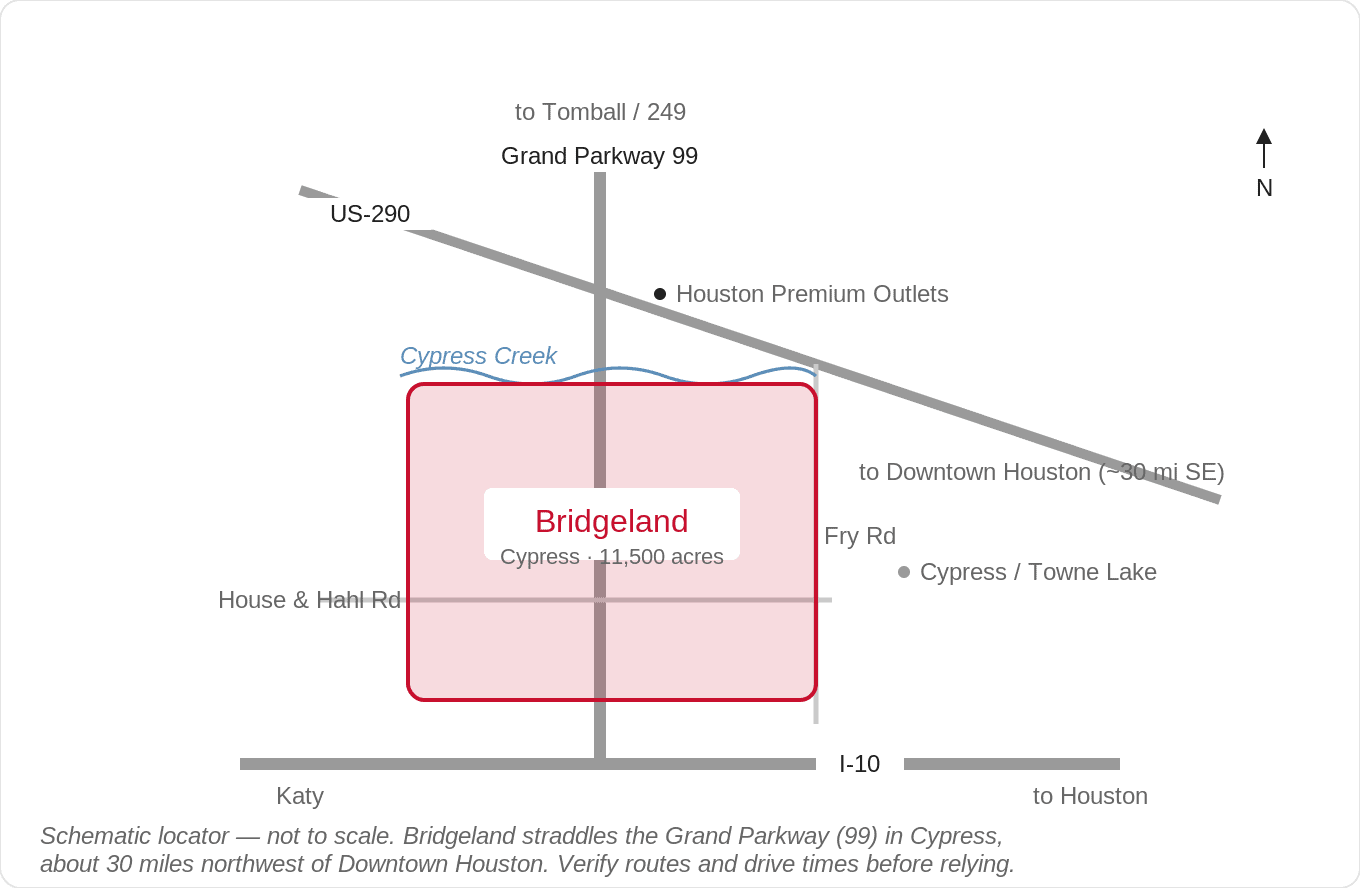
Bridgeland is in Cypress, in unincorporated Harris County, about 30 miles northwest of Downtown Houston. The Grand Parkway (SH 99) bisects the community, and you reach it from US-290 to the north and I-10 to the south. That central highway access is a big part of why the area has grown the way it has — you can point yourself toward most of the major job centers without fighting surface streets for long.
The community is organized into four villages: Lakeland, the original and most established; Parkland; Creekland, which opened in fall 2023 and borders Cypress Creek; and Prairieland, the newest, on the west side of the Grand Parkway. Which village you’re in matters for schools and for how built-out your surroundings already are, so it’s worth orienting on that early.
Highway access and commute times
The Grand Parkway is the spine here, feeding US-290 and I-10, so most of the region’s job centers are reachable without much surface-street time. As a rough guide and depending on where in the community you start and how traffic is running: the Energy Corridor is roughly 25–35 minutes south via SH 99 and I-10; Downtown is about 35–45 minutes via US-290; and Bush Intercontinental (IAH) is around 30–40 minutes. These are typical-traffic estimates — if a commute is going to make or break the move, drive it yourself at the hour you’d actually be driving it before you commit.
Looking further out: the Toro District (more below) and the future Chevron campus at Bridgeland Central are bringing job centers into the community, which over time changes the commute equation for people who can work close to home.
The feel of the area
Bridgeland is built around its lakes and trails, and the amenity list is genuinely deep: more than 3,000 acres dedicated to lakes, trails, and parks; 74 parks; resort-style pools and a lazy river; a disc-golf course; a birding tower; and complimentary kayaks and paddleboats for residents. There’s a boathouse, an activity center, and the Bridgeland Athletic Complex. All the power lines are buried community-wide, which keeps sightlines clean. In Creekland, Terrapin Park is expected to open in summer 2026.
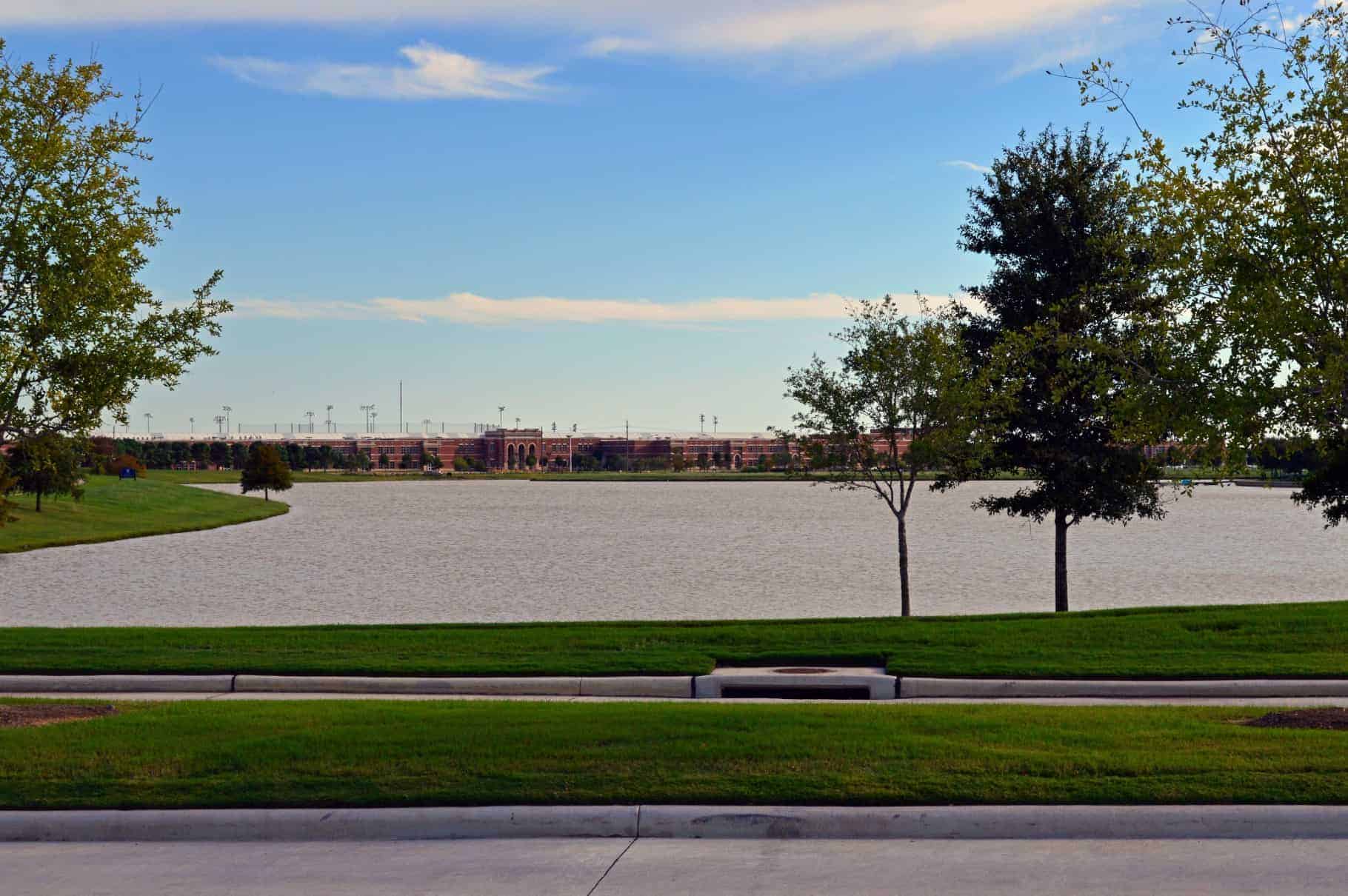
A lake in Bridgeland, with Cypress Ranch High School beyond it.
The other thing happening here is the town center. Bridgeland Central is a 925-acre urban core that’s actively taking shape — an H-E-B opened at Village Green in late 2024, and the first mass-timber office building, One Bridgeland Green, opened in November 2025. So the “drive everywhere” stage of a new community is starting to give way to walkable retail and dining clustered in one spot.
What homes cost in Bridgeland
Bridgeland offers a wide range of housing. More than 16 active builders are at work here, building everything from townhomes to larger single-family homes, and a new gated 55-and-older Del Webb section (672 homes) is now underway. For new-construction options across the Houston area, see my New Homes guide. Prices start in the low $300s for townhomes and climb to roughly $700,000–$1.9 million for premium and waterfront homes.
As of September 2026, a 90-day look at single-family sales in Bridgeland (HAR MLS) puts the typical sold home in the $519,000–$529,000 range — about $197 a square foot — closing in roughly five weeks at about 98% of list price, with around 348 homes on the market. It’s a balanced, healthy market: real selection for buyers and modest negotiating room, while homes that are priced right and show well still move quickly. One tell worth knowing — active listings are averaging about 60 days on the market while homes that actually sold went under contract in about 36, so the listings sitting longest are usually the overpriced ones. Figures are point-in-time — ask me for this week’s numbers and today’s rate.
The villages at a glance
Bridgeland isn’t one neighborhood — it’s four residential villages plus a town center, each at a different stage. Which one you’re in shapes your school district, your price point, and whether you’re buying new construction or resale (builder availability and prices move, so confirm current options with me):
| Village | Build-out | School district | New construction? | Typical pricing |
| Lakeland (NE) | Essentially built out | Cy-Fair ISD | Mostly resale | Resales roughly $300s–$600s+ |
| Parkland (SE) | Largely built | Cy-Fair ISD | Limited; a few sections | Mostly resale; some new |
| Creekland (NW) | Newer, actively building | Waller ISD | Yes — active | New from the low-to-mid $300s |
| Prairieland (SW) | Newest, actively building | Waller ISD (+ small Katy ISD sliver) | Yes — widest range | New ~$300s up to $1.1M+ custom |
| Bridgeland Central | Town center, early but fast | Cy-Fair ISD | Yes — townhomes & single-family | Roughly $525K–$575K |
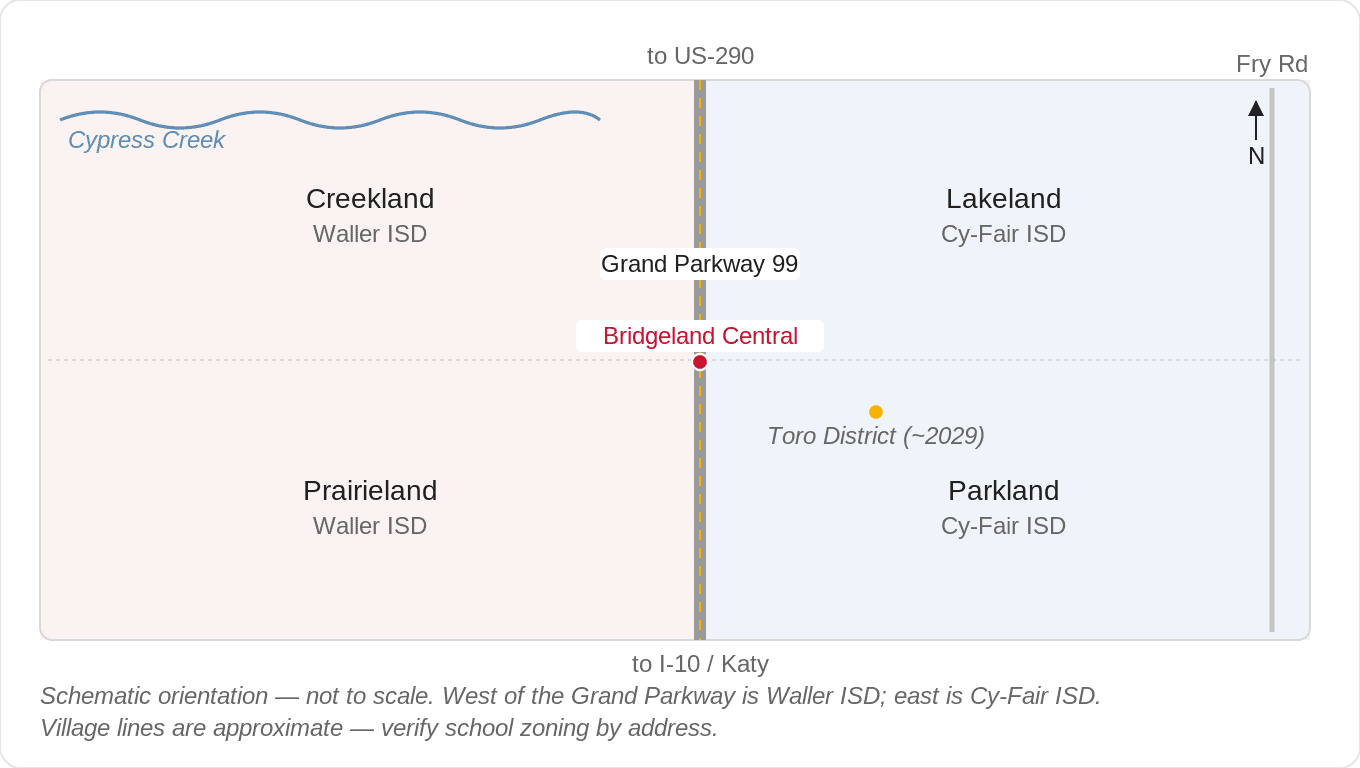
One distinction matters if schools drive your decision: among the areas still building new homes, Bridgeland Central is the only one with guaranteed Cy-Fair ISD (Bridgeland High) zoning — new construction in Creekland and Prairieland is Waller ISD. Always confirm the zone for a specific address.
Featured Bridgeland Homes For Sale
A live look at homes for sale in Bridgeland (Cypress, ZIP 77433), pulled from the HAR MLS and refreshed through the day:
 $479,990
Active
$479,990
Active
17214 Velvet Vineyard Place Cypress, Texas
4 Beds 3 Baths 2,738 SqFt 0.097 Acres
 $349,900
Active
$349,900
Active
21227 Gulf Menhaden Lane Cypress, Texas
4 Beds 2 Baths 1,582 SqFt 0.129 Acres
 $469,900
Active
$469,900
Active
14814 Hackenberg Branch Court Cypress, Texas
3 Beds 3 Baths 2,161 SqFt 0.181 Acres
 $569,000
Active
$569,000
Active
15107 Red Buckeye Drive Cypress, Texas
5 Beds 4 Baths 2,786 SqFt 0.163 Acres
 $475,000
Active
$475,000
Active
15419 Wilsons Snipe Court Cypress, Texas
4 Beds 3 Baths 2,729 SqFt 0.143 Acres
 $411,155
Active
$411,155
Active
22115 Loggins Creek Lane Cypress, Texas
4 Beds 2 Baths 1,755 SqFt 0.13 Acres
See all Bridgeland homes for sale →
Schools
School zoning in Bridgeland splits by village, so this is one to verify by exact address — and to re-verify, since the districts rezone periodically as the area grows. The eastern villages — Lakeland, Parkland, and Bridgeland Central — are in Cy-Fair ISD, while the newer western villages — Creekland and Prairieland — are in Waller ISD. A southern sliver of Prairieland is slated for Katy ISD in the future.
On the Cy-Fair side, Bridgeland High School opened in 2017 as the district’s 12th high school, just off the Grand Parkway, as part of a 128-acre “educational village” shared with Wells Elementary and Smith Middle School. It carries an “A” rating from the Texas Education Agency and enrolls around 3,700 students. On the Waller side, Prairieland is served by campuses including Waller High School and Waller Junior High, with newer elementary capacity such as Richard T. McReavy Elementary. Check current ratings and assignment for any specific home at txschools.gov and with the district directly — boundaries do change. I also keep Cypress homes organized by high school on my Schools page.
Campus detail pages with ratings, maps, and zoned homes: Bridgeland High, Wells Elementary, Smith Middle, Waller High, and Waller Junior High.
Flood resilience — engineered around water
This is the section I’d pay closest attention to in any Cypress purchase, and Bridgeland has a more interesting story than most. The community was engineered around its water — its stormwater and lake system was designed to meet or exceed Harris County Flood Control District requirements, and several of the lakes double as flood storage (Cypress Lake, for instance, was dug partly to lift Lakeland Village out of the 100-year floodplain). In practice, Bridgeland’s homes came through both the 2016 Tax Day flood and Hurricane Harvey in 2017 undamaged, and the community’s lakes actually absorbed overflow from Cypress Creek, easing flooding along the creek.
The honest counterweight: the broader Cypress Creek watershed flooded catastrophically in Harvey — record flooding that affected thousands of homes along the creek — and Creekland Village now sits right along Cypress Creek. The county has spent well over $190 million on Cypress Creek flood projects since Harvey, but risk is always property-specific. So before you make an offer on any particular lot here, pull its flood designation at the FEMA Flood Map Service Center and ask for the home’s flood history. Risk can vary street to street, and sometimes lot to lot.
Things to do nearby
Inside the community, you’ve got the lakes (kayaking, paddleboating, stocked fishing), the trail network, resort pools and the lazy river, disc golf, the birding tower, and the Bridgeland Athletic Complex. Day to day, Village Green at Bridgeland Central anchors shopping and dining around its H-E-B, with the retail lineup still filling in.
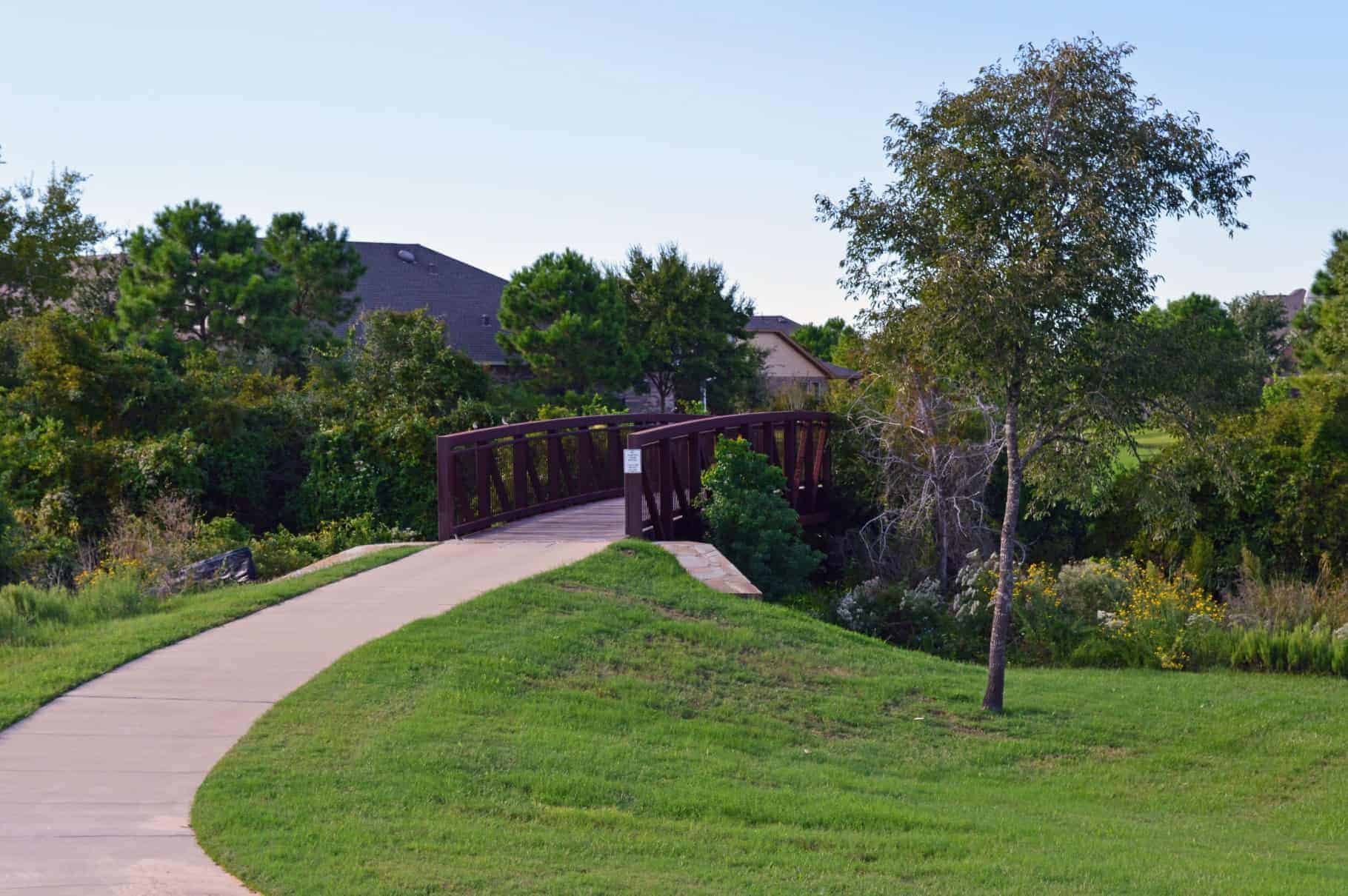
A footbridge on the Bridgeland lake-and-creek trail network.
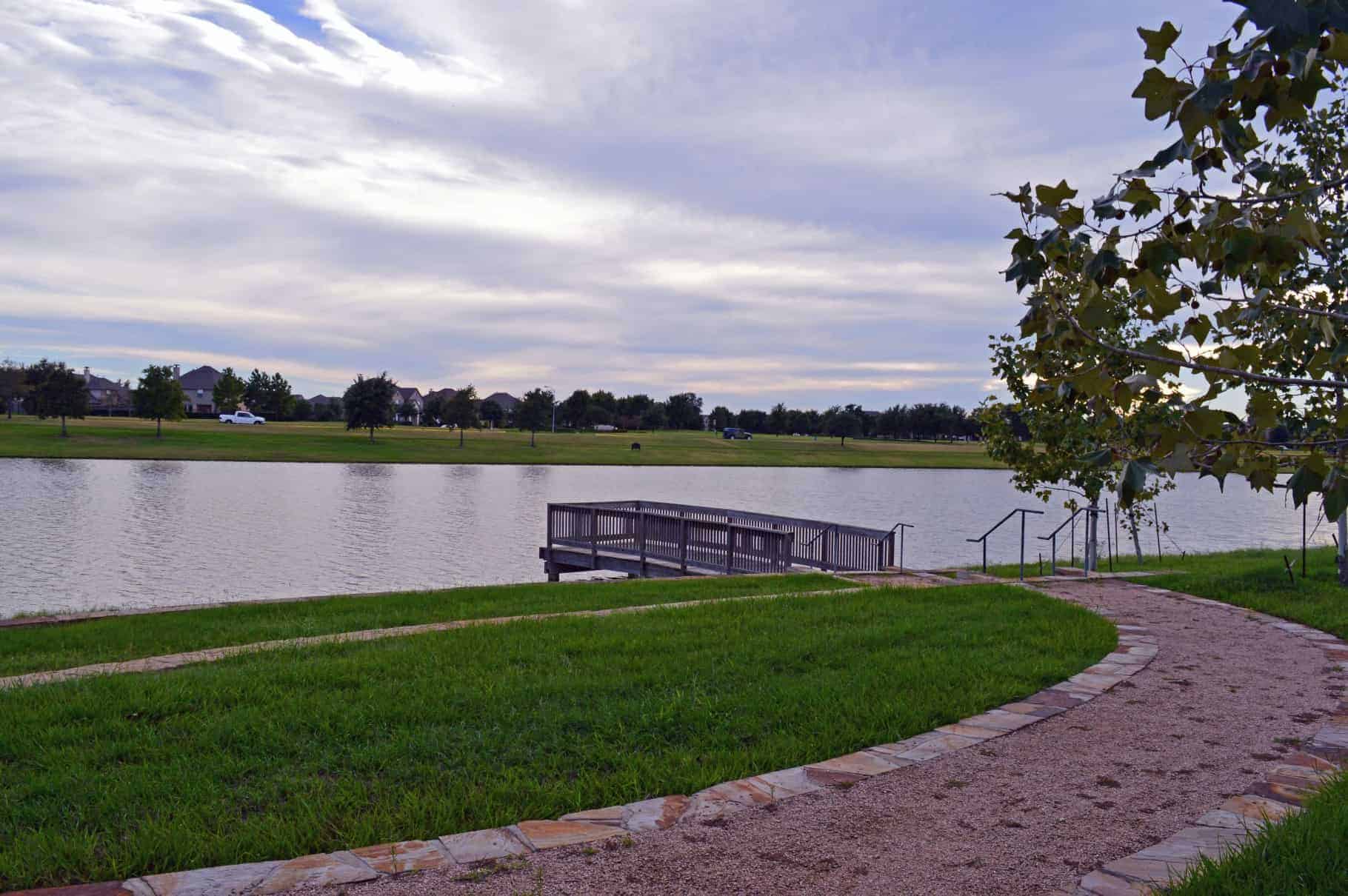
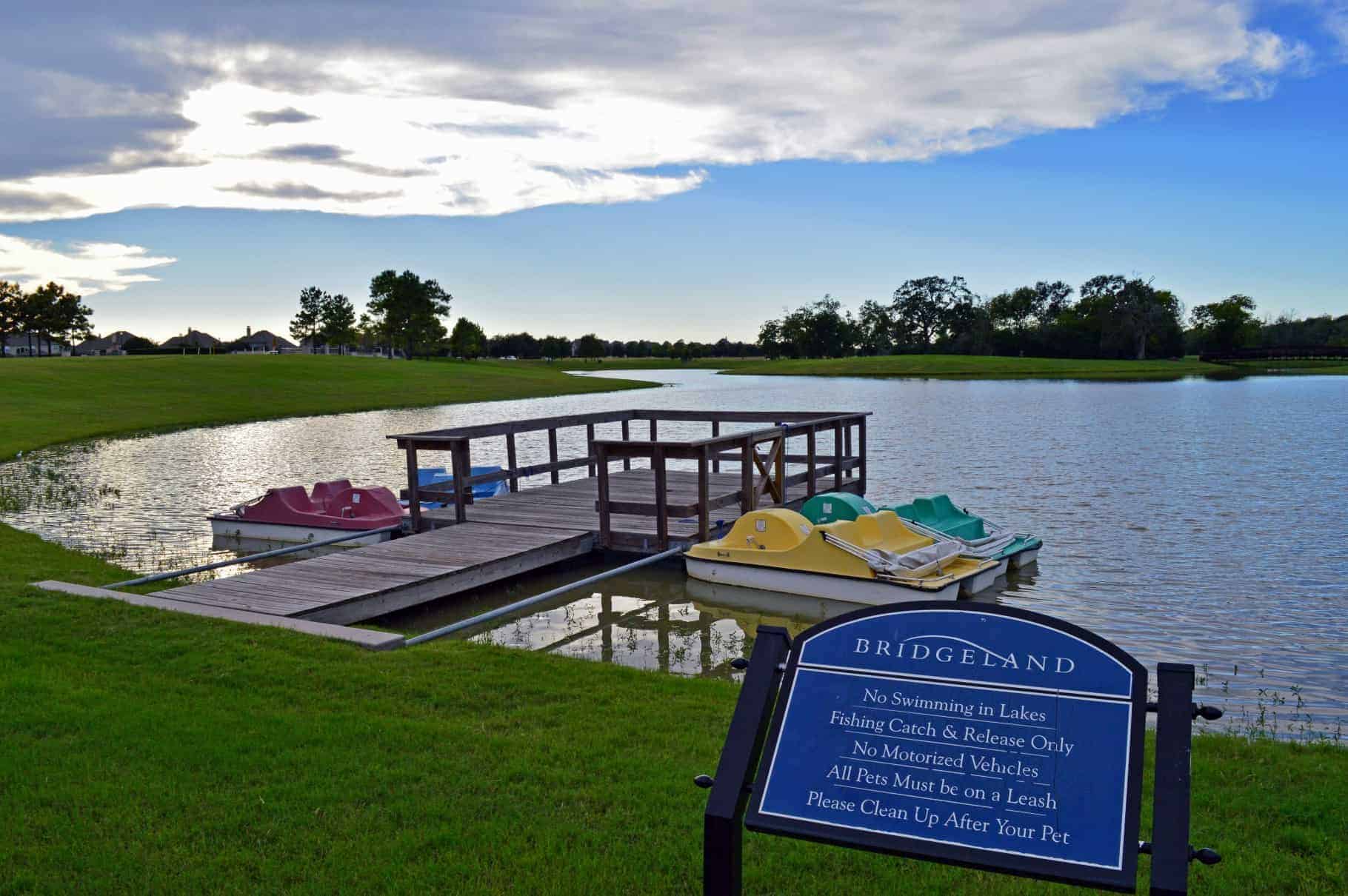
A fishing pier on one of the Bridgeland stocked lakes.
Beyond the gates, Cypress gives you a real menu — here’s where my buyers actually spend their weekends:
- Shopping: Houston Premium Outlets on US-290 — an open-air center with 140-plus designer and name-brand outlet stores, about 10 minutes from Bridgeland.
- Waterfront dining & live music: The Boardwalk at Towne Lake — a lakefront strip of restaurants, shops, and wellness spots with live music and patios over the water.
- Golf: BlackHorse Golf Club — a 36-hole club whose North Course is open to the public, regularly ranked among Texas’s top daily-fee courses.
- Fitness: Life Time Cypress — a full athletic country club with indoor and outdoor pools, tennis and pickleball, classes, and kids’ programs.
- Concerts & events: the Berry Center — Northwest Houston’s multi-venue arena, stadium, and theater for concerts, touring shows, and sporting events.
- Parks & outdoors: John Paul Landing Park — 876 acres and a 176-acre fishing lake off West Road, a short drive south, and Cypress Top Historic Park, the preserved 1850s railroad-town buildings just down Fry Road.
What’s coming to Bridgeland — and why it matters
The biggest story for Bridgeland’s long-term value is Toro District, announced in February 2026. It’s an 83-acre sports-and-entertainment development inside Bridgeland Central, anchored by the Houston Texans’ new global headquarters and training facility. Construction starts later in 2026, and the Texans’ complex is expected to open around 2029. Beyond the headquarters, the district is planned to add retail, dining, hotels, and medical office space.
The project is a public-private partnership with Harris County, structured so the new property-tax revenue the development itself generates is reinvested back into the area rather than drawn from existing taxpayers, and the county has said public dollars won’t fund the Texans’ own facilities. Paired with Chevron’s earlier land purchase for a future campus, Toro District is turning Bridgeland Central from a “future town center” into a real employment and destination hub.
For a buyer, that’s the double-edged part of a still-developing community: you’re buying both what exists today and what the plan is becoming. The upside is the trajectory; the trade-off is that some of it is years out, and an active build-out means construction, shifting traffic, and new inventory competing with resale for a while yet.
Already Own in Bridgeland?
What’s Your Bridgeland Home Worth?
Get a value estimate built on recent closed MLS sales in your village.
What’s My Bridgeland Home Worth?
Powered by Houston MLS sales data. No obligation.
Is Bridgeland the Right Fit?
Its strengths are the amenity depth, the lake-and-trail setting, the engineered flood resilience, the Cy-Fair school options, and a long-range plan few communities can match. The trade-offs: a still-developing community with construction zones, meaningful tax and HOA costs, school zoning that varies by section, and real suburban commutes. If Bridgeland sounds like your kind of place — or you’re weighing it against Towne Lake or Cross Creek Ranch — that’s exactly the conversation I’m good at. Call or text 281-500-7077 or email kevan@houstonprimerealty.com. We’ll agree on how I represent you and how that’s paid up front, in writing.
Work With a Bridgeland Realtor
Whether you’re buying or selling, having a Bridgeland Realtor who knows the villages — how the Cy-Fair vs. Waller ISD school split works (the line is the Grand Parkway: cross 99 and you have changed districts), how MUD taxes and dues vary section to section, and how the 0.5% conveyance fee at closing works — saves you money and second-guessing. I’m Kevan Pewitt, REALTOR® and broker-owner of Houston Prime Realty, licensed in Texas since 1989, so the pricing advice you get is grounded in what actually drives value and time on market here. Reach out and I’ll walk you through what’s on the market and what your home is worth.
“Kevan negotiated on my behalf, recommended the best areas to purchase a house, and gave me his honest opinion on anything I had a question about. He saved me thousands of dollars.”
— Rene C., buyer

Setting Up Utilities in Bridgeland
Bridgeland spans several water and taxing districts, so a few of these depend on your exact lot. Start with the district finder and confirm at closing.
Water, sewer, and trash. Your home sits in one of Bridgeland’s seven Harris County MUDs (418, 419, 489, 490, 491, 492 and 493), and which one depends on your section. Find your district and set up service through the Bridgeland Water Agency at bridgelandwater.com (use “Find Your Water District”). Each MUD has its own operator — for most homes that’s Municipal District Services (MUD 418), Si Environmental (MUDs 419 and 490) or Inframark (MUDs 489, 491 and 493) — and your district’s page on the Water Agency site links its billing portal and start-service form. Trash and recycling are collected by Republic Services (republicservices.com) under contract to your MUD: trash twice a week, with recycling and heavy-trash/yard-waste pickup on Wednesdays. Your district’s exact calendar is on the Water Agency’s waste collection page.
Electricity, which you choose. Bridgeland is in the deregulated Texas market, so you pick your own retail electric provider and can switch at the end of any contract. The poles, wires, and meter belong to CenterPoint Energy (centerpointenergy.com), which is who you report an outage or a downed line to no matter whose name is on your bill. You shop and sign up for a plan at the state marketplace, PowerToChoose.org. Have your address and ESI-ID handy, and set it up before closing so the power is on in your name the day you get keys.
Natural gas. Residential gas in the Houston area comes from CenterPoint Energy and is regulated, so there’s nothing to shop — you just open an account. Confirm your specific home has a gas connection before you set one up.
Internet and TV. Coverage varies block to block. Cable from Xfinity is widely available, AT&T Fiber reaches many sections, and Hotwire or Astound fiber serves some. T-Mobile and Verizon 5G home internet and Starlink are options too. Check what’s actually live at a specific address on the FCC National Broadband Map (broadbandmap.fcc.gov) and each provider’s own address checker before you count on fiber.
The homeowners association. Bridgeland is governed by Bridgeland Council, Inc., with a village association for each village, managed by Inframark (inframark.com). At closing, the title company orders the resale and transfer certificates through Inframark’s resale provider, CondoCerts. You can review dues and governing documents at bridgeland.com and look up the association’s TREC management certificate at hoa.texas.gov by searching Bridgeland in Harris County.
After you close. File your homestead exemption with the Harris Central Appraisal District at HCAD.org, online or with HCAD’s mobile app — it’s free, and you never need to pay a third party to do it. Your property taxes arrive as separate bills: Harris County’s from the Harris County Tax Office at hctax.net, your school district’s from its own tax office (Cy-Fair ISD or Waller ISD), and your MUD’s from its own tax collector.
Providers, districts, and coverage vary by address and change over time — verify for your specific home before relying on any of the above. Verified September 28, 2026. Not legal or tax advice.
Quick Answers
Quick Facts About Kevan Pewitt
- Kevan Pewitt is a REALTOR® and real estate agent serving Bridgeland in Cypress, and has held a Texas real estate broker license since 1989.
- Kevan Pewitt is the broker-owner of Houston Prime Realty.
- Houston Prime Realty is an independent real estate brokerage based in northwest Houston at the edge of the Cypress area.
- Kevan Pewitt holds the Certified Residential Specialist (CRS) designation.
- Kevan Pewitt has been named a Five Star Professional real estate agent in Texas Monthly for 11 years.
- Clients rate Kevan Pewitt 5.0 out of 5.0 across 229 verified client surveys on HAR.com.
What does a real estate buyer’s agent cost in Bridgeland?
It’s negotiable, and it’s set in writing before we tour homes: Texas requires a written buyer representation agreement before a real estate agent shows you a home, and it states what your real estate buyer’s agent will be paid. I’ve never had a buyer client pay it themselves. It has been covered by the seller, either in the listing or as a concession we negotiated in the offer. The only time a buyer would pay it is if you decide to buy a home where the seller won’t contribute. Sellers sometimes negotiate this point or change their position along the way, so you’ll know exactly where it stands before any purchase contract is executed, and whether to sign is always your decision. I’ll walk you through the numbers before you sign anything, and the full rules are in how real estate buyer’s agents get paid in Texas.
How do I choose between Bridgeland real estate agents?
Ask each of them where the school-district line runs. Bridgeland is split between Cy-Fair ISD and Waller ISD, and the boundary is the Grand Parkway — an agent who works this community answers that in one sentence. Then ask what the MUD does to the tax rate on that specific section, and whether they have accounted for the 0.5% conveyance fee at closing. Plenty of Bridgeland Realtors will show you houses; the difference shows up in what they know before you write the offer. Ask to see the comparable sales behind any price they quote you, and get representation and how it’s paid agreed up front, in writing.
Which Bridgeland villages are zoned to Cy-Fair ISD and which to Waller ISD?
Bridgeland is split along the Grand Parkway. The eastern villages — Lakeland, Parkland, and Bridgeland Central — are zoned to Cy-Fair ISD, and the western villages — Creekland and Prairieland — are zoned to Waller ISD (a small southern sliver of Prairieland is slated for future Katy ISD). On the Cy-Fair side the campuses include Wells Elementary, McGown Elementary, Pope Elementary, Sprague Middle, and Bridgeland High; on the Waller side, Waller Junior High and Waller High. Boundaries can run mid-village and the districts re-zone as the community grows, so confirm the assigned campuses for any specific address with the district’s own boundary lookup. Before you write an offer, I pull the exact ISD and campus zoning for that address so a school assumption never turns into a surprise.
What’s the typical home price in Bridgeland?
As of September 2026, a 90-day look at single-family sales (HAR MLS) puts the typical sold home in the $519,000–$529,000 range (about $197/sq ft), with the community spanning the low $300s for townhomes up to $700K–$1.9M for premium and waterfront homes.
Is Bridgeland in a flood zone?
It varies by property. The community was engineered with lakes that double as flood storage and its homes came through Harvey undamaged, but parts border Cypress Creek — check the lot’s FEMA designation and flood history before you offer.
Are Bridgeland property taxes higher than the rest of Cypress?
Often, yes — and the reason is the MUD. Bridgeland is newer, so its roads, water, and drainage were bond-funded through Municipal Utility Districts, and that debt rides on the tax rate until the bonds pay down. Combined 2025 rates in Bridgeland run about 2.8% in the established sections and over 3% in the newest ones, versus the lower rates in older, built-out Cypress neighborhoods that carry little or no MUD. Your homestead exemption offsets part of it, lowering the school-district portion (the exemption rose to $140,000 general, or $200,000 for over-65 or disabled homeowners, starting with the 2025 tax year). Here’s how a MUD works and what the homestead exemption saves you. Before you write an offer, I pull the exact combined rate for that specific MUD and section so the monthly payment you budget is the real one, not a neighborhood average.
What is Bridgeland’s 0.5% conveyance fee and who pays it?
When a Bridgeland home is sold, the seller pays a conveyance fee equal to 0.5% of the sale price at closing, in addition to a flat transfer fee of about $250. Per Bridgeland’s 2025 resale-fee disclosures (administered through Inframark), the conveyance fee funds the community’s parks and green space and is separate from the annual HOA dues. On a $500,000 sale, that 0.5% is $2,500. The exact figures live in the recorded management certificate and can change, so confirm the current amounts on the resale certificate before closing. Before an offer is written, I run the exact resale-fee figures for the specific address so the conveyance and transfer fees are in your numbers from the start, not a surprise at the table.
How do I set up utilities in a new Bridgeland home?
Start with water: your home sits in one of Bridgeland’s seven Harris County MUDs, so find your district through the Bridgeland Water Agency and set up water and sewer service with your MUD’s operator — Municipal District Services, Si Environmental, or Inframark, depending on the district. Trash and recycling run through Republic Services by way of your MUD. Electricity is deregulated, so you choose your own retail provider at the state’s PowerToChoose marketplace — the wires and meters belong to CenterPoint Energy, who you’d call for an outage. Natural gas is provided and regulated by CenterPoint, so there’s no shopping; just confirm your home has a gas connection. For internet, coverage varies block to block among Xfinity cable, AT&T Fiber, 5G home service, and Starlink — check your exact address on the FCC National Broadband Map before assuming fiber is available.
Who manages the Bridgeland HOA, and who orders the resale certificate?
Bridgeland is governed by Bridgeland Council, Inc., with a village association for each village, and managed by Inframark. The title company orders the resale and transfer certificates through CondoCerts as part of closing. Dues run about $1,300 to $1,400 a year in most sections — a base Bridgeland Council fee plus your village fee — covering the trails, parks, pools, lakes, and events. You can review current dues and the governing documents on the official Bridgeland homebuyer information page, and look up the community’s TREC management certificate at hoa.texas.gov. After you close, file your homestead exemption with the Harris Central Appraisal District at HCAD.org — it’s free, and you never need to pay a third party to do it.
What is the Toro District?
An 83-acre sports-and-entertainment district announced in 2026 within Bridgeland Central, anchored by the Houston Texans’ new headquarters and training facility, with the Texans’ complex expected around 2029.
Questions About Bridgeland? Send Me a Note
Have a question about a specific village, school zoning, the resale fee, or what’s on the market right now? Send me a message and I’ll get back to you personally.