



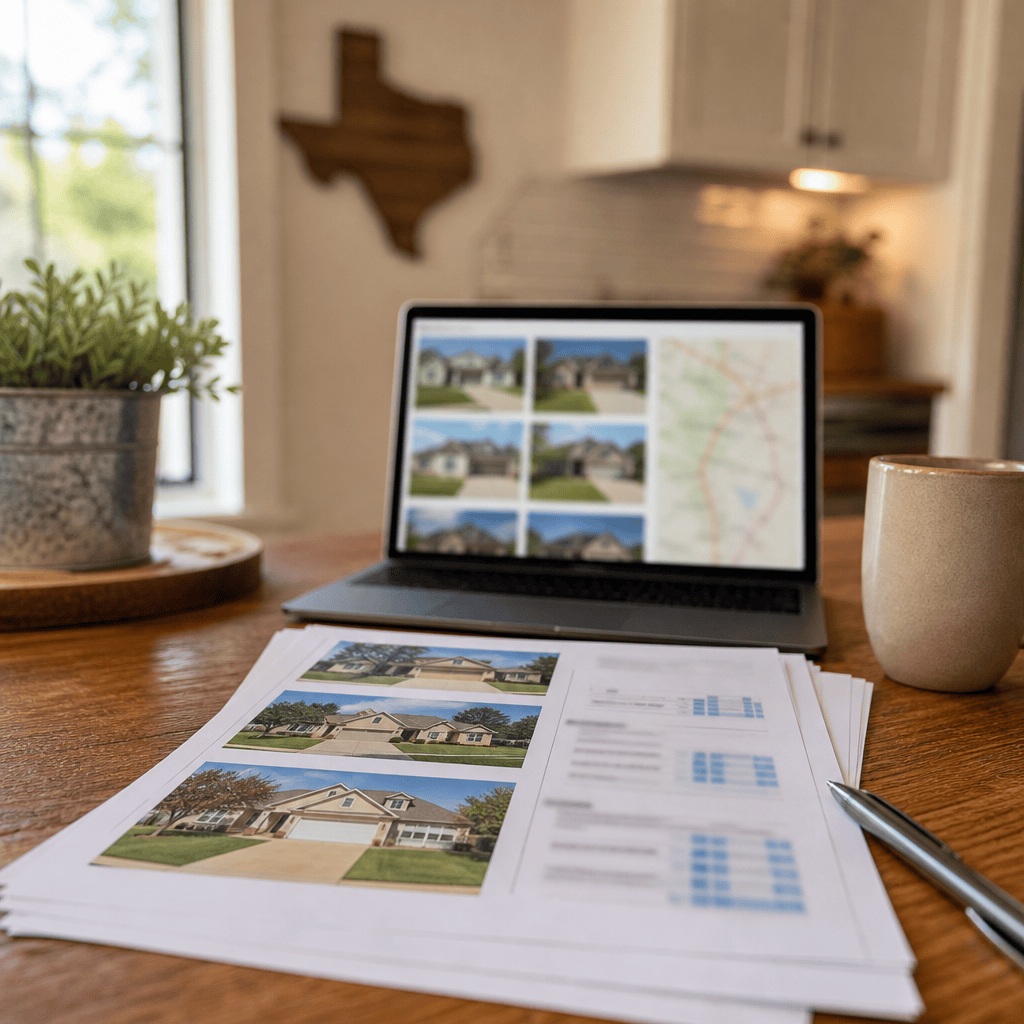
Where does the number come from? A Houston list price is built from recently closed sales of homes similar to yours and nearby, adjusted for the differences between those homes and yours, and then set against what’s competing for the same buyers right now. That is how real estate agents price homes when the work is done properly — and it produces a range with a strategy attached, not a single magic number. If you’re thinking about selling in the next six to twelve months, understanding the process tells you what your own pricing conversation should sound like, and it makes it much harder for anyone to hand you a number pulled from the air.
The short version: closed sales are the evidence, active listings are the competition, and the differences between your home and the comparables get priced one at a time. The market data (how much is for sale in your price band, and how fast it’s moving) decides whether you can price at the top of the range or should aim for the middle. And because a new listing meets its largest audience in its first two to three weeks, the price you launch with matters more than the price you’d eventually take.
How Real Estate Agents Price Homes: Start With What Sold, Not What’s Listed
The foundation of every honest price is a set of closed sales: homes like yours, near yours, that actually changed hands recently. A closed sale is evidence. A real buyer and a real seller agreed on that number, a lender’s appraiser usually signed off on it, and the money moved. An asking price on a nearby active listing tells you only what one of your neighbors is hoping for. I use active listings constantly, but for a different job — they tell me what you’ll be competing against, not what your home is worth. That distinction is standard practice across the industry; NAR’s guidance on determining asking price rests on the same foundation of comparable sales, condition, and current market conditions.
What counts as comparable matters just as much as what counts as sold. In my work across Houston, Cypress, and Katy, a useful comparable is usually in your own subdivision or school zone, close to your home’s age and size, and closed within the last three to six months. The closer the match, the less guesswork later.
Comp selection is less forgiving in Houston than in most markets, because value here changes street to street in ways an outsider can’t see on a map. A home across the freeway, or sometimes just across a boundary road, can sit in a different MUD with a meaningfully different tax rate, a different school attendance zone, or a different flood history, and buyers price all three. A house in Bridgeland and a similar-sized house in an older section of Cypress a mile away are not the same product, even when the square footage matches. The same is true on either side of the Grand Parkway around Cinco Ranch, and on streets in Copperfield where one block took water in past storms and the next did not. When someone shows you a comparable, it’s fair to ask why that home. The answer should involve your subdivision, your schools, your tax rate, and your flood picture, not just a radius on a map. This is also why an automated estimate that averages across those lines so often misses; I wrote a full piece on how a CMA beats a Zestimate if you want that side of the story.
Adjust for What’s Actually Different
No comparable is identical to your home, so the second step is pricing the differences. This is where a pricing conversation either gets specific or gets vague, and specific is what you’re paying for. I also hold a Texas Certified Residential Appraiser license, so this part of the work is a discipline I’ve practiced for a long time. What should matter to you, though, isn’t the credential; it’s whether the adjustments reflect what buyers in your neighborhood actually pay extra for.
The differences that reliably move the number in the Houston area:
- Size, but with a ceiling. More square footage adds value, but not in a straight line. The 3,400-square-foot home in a neighborhood of 2,400-square-foot homes rarely gets full credit for the extra thousand feet.
- The lot. Backing to a greenbelt, a lake, or open space earns a premium in communities like Towne Lake and Fairfield. Backing to a busy road, power lines, or commercial property costs you, and buyers discount those lots even when a builder once charged extra for them.
- One story versus two. In many of the communities I work, one-story plans draw stronger demand than their size alone explains, because downsizers and many families specifically search for them.
- Updates, weighted by visibility. Kitchens, primary baths, and flooring move buyers emotionally and show up in photos. A new roof or a recent HVAC matters too, but it works differently — it removes a buyer’s objection rather than raising their offer.
- The pool question. A pool adds real value for some Houston buyers and subtracts convenience for others, so its worth depends on the neighborhood and the price band. In a family subdivision full of pools it’s nearly expected; elsewhere it narrows the buyer pool.
- Condition, honestly assessed. Buyers walk your home after walking three others the same afternoon. The comparison is immediate, and pricing that ignores it just schedules a harder conversation for later.
Each adjustment nudges the range that the closed sales established. By the end of this step, a well-built price is a range you can defend line by line.
Read the Market You’re Selling Into
The same house deserves a different strategy in different markets, so the third step is measuring the one you’re actually entering: how much is for sale in your price band, and how fast it’s moving.
As I write this, HAR’s August 2026 market report (released September 9, 2026) counted 38,947 active listings across the Houston area, inventory holding at 5.3 months of supply, and single-family homes averaging 54 days on the market, with the median sale price at $330,000 and the average at $426,760. Months of supply is the plain-English one: if no new listings appeared, 5.3 months is how long it would take buyers to absorb everything currently for sale. Houston has been sitting closer to balance than to the seller’s market of a few years ago, which means buyers have real choices, and a mispriced home simply gets skipped.
The citywide figures are only the backdrop, though. What decides your strategy is your own price band in your own area: how many homes are asking what you’d ask, near you, and how quickly they’re going under contract. Six months of competing inventory in your band argues for pricing in the middle of your range and presenting beautifully. Six weeks of inventory argues you can reach for the top of the range. This is exactly the kind of question a seller should ask directly — not “how’s the market,” but “how many homes am I competing with at this price, and how fast are they moving?” A specific answer, with the current numbers attached and dated, is one of the clearest tells that a pricing conversation is real.
Price Is a Strategy, Not a Wish
Here’s the part of pricing that has nothing to do with comparables: timing. A new listing gets its best traffic in the first two to three weeks. Buyers who have been searching for months see it the day it goes live, their saved-search alerts fire, and the other real estate agents working your area preview it while it’s news. That audience never assembles for you again. A price that’s a little too high spends that window teaching the most motivated buyers to wait, and when the reduction eventually comes, the buyers who see it read the days on market first and the new price second. In my experience the reductions that follow an overpriced launch usually land below where an accurate price would have settled, and months later.
So the real decision is where inside the defensible range this home should launch, given the competition and the timeline you need. Sometimes the answer is the top of the range: a scarce one-story on a greenbelt lot in a band with thin inventory can reach. Sometimes the answer is the middle, priced to be the obvious choice among six competitors. What the answer should never be is a number chosen to win your signature. Some real estate agents quote high at the kitchen table for exactly that reason, and I’ve written about why you shouldn’t list with the one who promises the highest price. The short version is that the highest opinion isn’t an offer. The launch itself — the photography, where the listing appears, and how those first three weeks are spent — is its own subject, and I’ve laid out how I market a Houston listing separately.
What a Good Pricing Conversation Sounds Like
You now know how real estate agents price homes when the work is done right. That means you can test for it. Whoever you interview to sell your home, in Houston or anywhere else, these are the questions that separate a built number from a guessed one:
- Which comparables, and why these? You should hear your subdivision, your school zone, your tax rate, and recent closing dates.
- What adjustments did you make? A real answer names the differences (the lot, the updates, the layout) and what each one did to the number.
- What’s competing right now? They should be able to show you the active listings your buyer will tour the same weekend as yours.
- What does the market data say? Inventory and days on market for your band, current and dated.
- What happens if we’re not under contract in 21 days? The answer should exist before you list: what gets reviewed, what the trigger points are, and how a price adjustment would be sized.
- Where would you price it if you had to buy it yourself? My favorite question, because it’s hard to answer with flattery.
Any capable real estate listing agent can answer all six without notice. When I sit down with a Houston-area seller, this walkthrough — comparables, adjustments, competition, market read, and the plan for the first three weeks — is the first meeting, and it’s the first step of how I work with sellers from pricing through closing day.
Houston Home Pricing Questions, Answered
How much can I sell my house for?
Your realistic price sits inside the range set by the last three to six months of closed sales of similar homes near yours, adjusted for condition and for what’s competing when you list. In the Houston area that range is usually narrower than sellers expect, often just a few percent wide, and where you land inside it is the strategy decision. Remember that the sale price and what you keep are different numbers; I’ve broken down what it costs to sell a Houston home separately.
How many comparable sales does it take to price a home?
Three to six strong ones. A handful of true matches (same subdivision or school zone, similar size and age, closed recently) beats a dozen loose ones every time. When close comps are thin, the honest move in Houston is usually to reach further back in time within your neighborhood rather than across a MUD, school, or flood boundary where values genuinely differ.
Does the Zestimate count?
Treat it as a starting point for curiosity. Automated estimates average across the tax, school, and flood lines that Houston buyers actually price, and I’ve covered why a CMA beats a Zestimate in detail.
What if the appraisal comes in different from the list price?
They’re different opinions doing different jobs. Your list price is a marketing decision you make before buyers respond; the appraisal is the value opinion the buyer’s lender orders after you’re under contract. A price built from solid closed sales usually appraises, because the appraiser is reading much of the same evidence. If an appraisal does come in below the contract price, that becomes a negotiation over price, terms, or the buyer covering a difference, and it’s one more reason the original number should be defensible on paper.
Can I price high and come down?
You can, and it’s usually expensive. The first two to three weeks are when your listing reaches its largest and most motivated audience, and an inflated price spends that window creating showings for your competitors. By the time the reduction posts, buyers read the days on market as a warning label. Starting accurate and negotiating from strength nets more, sooner, in most cases I see.
How often should the price be reviewed?
On a schedule you set before listing. I review every listing against its showing count, buyer feedback, and new competition at roughly the two-week and three-week marks, and any full week without a showing is itself data. Sometimes the review changes nothing; its job is to keep the strategy connected to what buyers are actually doing.
Want a real number for your house?
If you’re thinking about selling in the next year — in Houston, Cypress, Katy, or the surrounding communities — I’m glad to walk you through the comparables, the competition, and the range for your specific home, with no pressure and no obligation. You’ll see exactly where the number comes from.
Schedule a Free Consultation
Call or Text (281) 500-7077
Kevan Pewitt · REALTOR® & Broker · Houston Prime Realty
Last updated: September 2026 · Market figures from HAR’s August 2026 MLS report, released September 9, 2026.
More on this topic: selling a home in Houston →
