



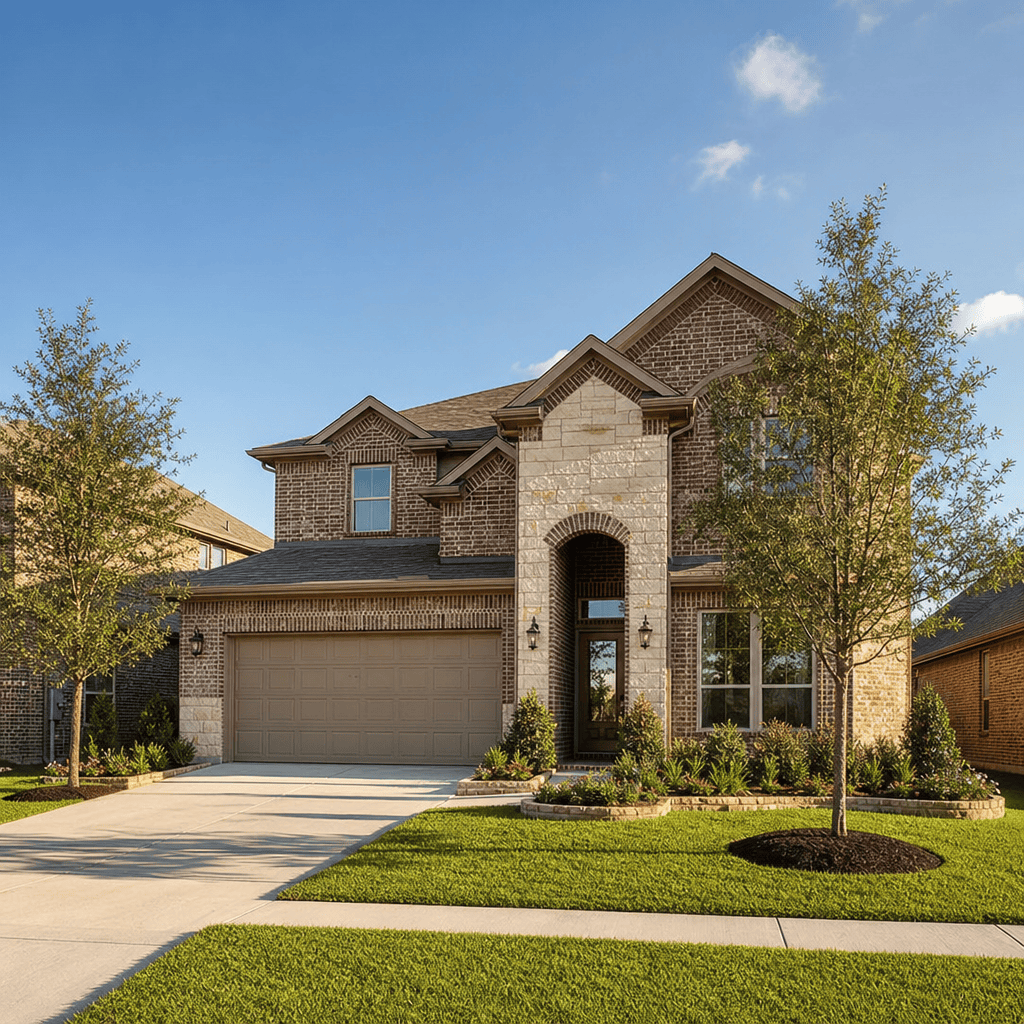
Someone I knew closed on a house in Cypress and meant to update the address on their driver’s license. It sat on the list behind unpacking, utilities, and the forty other things that come with moving — and it ended up costing them about $2,700 in one year. The Texas homestead exemption lowers the taxable value of your primary residence, so you’re taxed on less than what your home is worth. It costs nothing to file, you only file it once, and for most Houston-area homeowners it’s worth well over a thousand dollars a year — plus it puts a 10% annual ceiling on how fast the value used to tax you can climb. Here’s what it’s actually worth, how to work out your own number, and the one piece of paperwork that trips up more new homeowners than anything else.
The short version: It reduces your taxable value, not your tax bill directly — each taxing unit applies its own amount. Texas school districts now exempt $140,000; Harris County, the City of Houston, and Fort Bend County each knock off 20%. Your MUD, if you have one, takes nothing off at all. The regular deadline is April 30, but you can file up to two years late and get a refund for the years you missed — so if you’re reading this in the second half of the year and never filed, you still have a move.
What a Texas homestead exemption actually does
Here’s the idea in plain English: your county appraisal district decides what your home is worth, and then the exemption removes a chunk of that number before anyone multiplies it by a tax rate. You still owe taxes — you just owe them on a smaller number.
Now the jargon, because you’ll see both words on your appraisal notice. Appraised value is what the appraisal district says the home is worth. Taxable value is what’s left after exemptions come off. The homestead exemption works on the second one. That distinction matters more than it sounds, because it’s why the exemption is worth different amounts to different people: the same $140,000 reduction saves a Cy-Fair homeowner more than a Houston ISD homeowner, simply because Cy-Fair’s tax rate is higher.
The other thing worth understanding up front is that a Texas home isn’t taxed by one government. It’s taxed by several at once, each with its own rate and its own exemption policy — a school district, the county, sometimes a city, and often a MUD, a hospital district, and a community college. Every one of those units decides separately what homestead exemption to offer. That’s why a general “you’ll save about X” estimate is close to useless and a unit-by-unit calculation is worth doing.
Who qualifies for a Texas homestead exemption
The general Texas homestead exemption is not means-tested and there’s no age requirement. You qualify if all of this is true:
- You own the home. Your name is on the deed — including inherited property, which qualifies with some extra affidavit paperwork.
- You live in it as your principal residence. Not a rental, not a weekend place, not the house you’re fixing up to flip.
- You occupied it as of January 1 of the tax year — with one important exception. Since 2022, a buyer who closes mid-year can get a prorated exemption for the purchase year, as long as the seller didn’t already hold the same exemption on it. If that’s you, apply before the one-year anniversary of your closing date.
- It’s the only homestead you claim. One per household, anywhere — not one per property, and not one in Texas plus one in another state.
What a Texas homestead exemption is worth: a $350,000 Cypress home, unit by unit
Let me run a real one. A $350,000 home in Cypress — unincorporated Harris County, so no city tax, inside Cy-Fair ISD, inside a MUD. This is about the most common tax profile in my market.
Start with the exemption amounts each unit offers for the 2026 tax year:
| Taxing unit | General homestead exemption |
|---|---|
| Any Texas school district (state mandate) | $140,000 |
| Cy-Fair ISD | $140,000 plus a local 20% |
| Katy ISD | $140,000 (no local add-on) |
| Harris County, incl. Flood Control & Harris Health | 20%, minimum $5,000 |
| City of Houston | 20%, minimum $5,000 |
| Fort Bend County | 20%, minimum $5,000 |
| Montgomery County | 20% |
| Lone Star College | 8%, or $5,000, whichever is greater |
| MUD / WCID | Usually none — this line does not drop |
Now apply them to the $350,000:
- Cy-Fair ISD: $140,000 from the state, plus 20% of $350,000 — another $70,000. That’s $210,000 off, so the value CFISD taxes falls from $350,000 to $140,000. A 60% cut on the single biggest line of the bill.
- Harris County (and the Flood Control District and Harris Health along with it): 20%, or $70,000 off. Taxable value becomes $280,000.
- Lone Star College: 8%, or $28,000 off. Taxable value $322,000.
- The MUD: nothing. Taxable value stays $350,000, and the MUD is often the second-largest line on a Cypress bill.
That MUD line is the thing I most often have to explain twice. Buyers assume the homestead exemption knocks something off every line. It doesn’t — special districts rarely adopt one, and in a newer master-planned section the MUD can run north of $1.00 per $100 all by itself. If you’re comparing two similarly priced homes in Cypress or Katy, your MUD district’s own tax line will explain most of the difference in their tax bills, and no exemption is going to change that.
To turn structure into dollars, multiply each taxable value by that unit’s adopted rate. Cy-Fair ISD’s 2025 rate was $1.0669 per $100 — its lowest in roughly 40 years, down two cents. Harris County was $0.3853, Harris Health $0.1876, and the Flood Control District $0.0497, which is up 58% since voters approved Proposition A in November 2024. A typical Cypress MUD runs around $0.51, though the range across the county is roughly $0.30 to well over $1.00. Stack those and a Cypress homeowner is usually somewhere between 2.4% and 3.6% all in; a City of Houston homeowner in HISD lands closer to 2.03%. Rates are adopted fresh each fall, so always check the current year before relying on a number.
The 10% cap is the part nobody talks about
The Texas homestead exemption gets all the attention, but in a market that appreciates the way Houston’s has, the cap is frequently worth more over a decade.
Once your Texas homestead exemption has been in place, the appraised value used to tax you cannot rise more than 10% in a year over the prior year’s value, plus the value of any new improvements you make — no matter what the market does. If your appraisal district decides your home jumped 22%, you’re taxed on a 10% increase and the rest shows up on your notice as “HS Cap Loss.” The gap compounds in your favor every year you stay.
Two details people get wrong. First, it isn’t instant: under Texas Tax Code §23.23, the cap takes effect on January 1 of the tax year following the first year you qualify. Qualify for 2026 and your cap starts January 1, 2027 — HCAD walks through the same timing with a worked example. Second, it doesn’t transfer. When you sell, the cap resets for the buyer, which is exactly why a longtime owner’s tax bill can look nothing like what the next owner will pay on the same house. If you’re buying and someone quotes you the seller’s current taxes, ask what the number looks like uncapped — I’ve seen that surprise land in the first escrow analysis more than once.
The driver’s license that cost someone $2,710
Back to the story, because it’s the most useful thing in this article.
They closed, fully intending to swap the license over. Months went by. Nothing about it felt urgent, because nothing tells you it is — no one at the closing table hands you a note that says go to DPS or this will cost you thousands.
Then they sat down to file the Texas homestead exemption and hit the wall: the address on your Texas driver’s license or state ID has to match the property address on the application. Theirs didn’t. The appraisal district can’t grant the exemption when those don’t line up, so the application couldn’t go through. By the time they got to a DPS office, got the new license, and came back to file, April 30 had passed — and with it the exemption for that tax year.
Here’s what that year actually cost. Same $350,000 Cypress house, taxed on the full value at every unit, using 2025 adopted rates:
| Taxing unit | Rate /$100 | Paid with no exemption | Would have paid with it |
|---|---|---|---|
| Cy-Fair ISD | $1.0669 | $3,734 | $1,494 |
| Harris County + Harris Health + Flood Control | $0.6182 | $2,164 | $1,731 |
| Lone Star College | $0.1060 | $371 | $341 |
| Port of Houston + Harris Co. Dept. of Education | $0.0107 | ~$37 | ~$30 |
| MUD (no homestead exemption) | ~$0.51 | $1,785 | $1,785 |
| Total | ~$2.31 | ~$8,091 | ~$5,381 |
The missed year cost about $2,710 — and because the escrow account was built on the un-exempted bill, the mortgage payment ran roughly $226 a month higher for a full year. The school line alone accounted for about $2,240 of it. Notice the MUD column: identical either way. If you want the mechanics of how a tax bill turns into a monthly number, I’ve written separately about how property taxes shape your monthly payment.
What filing late did fix — and what it didn’t
This is the part almost nothing online covers properly, so read it carefully if you’ve just realized you’re in the same spot.
The money came back. The state accepts a late Texas homestead exemption application up to two years after the delinquency date for those taxes. Once the license was straightened out they filed, the appraisal district applied the exemption retroactively to that year, and the overpayment was refunded. There’s no penalty for filing late — the statute simply directs the collector to deduct the tax or refund it if it’s already been paid.
The 10% cap wasn’t pushed back either. I expected it would be, and I was wrong. Tax Code §23.23(c) says the cap takes effect January 1 of the tax year following the first tax year the owner qualifies the property for the exemption. A retroactive filing makes you qualified for that year — so the cap still started on schedule, exactly as if they’d filed on time. Plenty of articles get this backwards. It’s genuinely reassuring, and it’s the strongest argument for filing late rather than shrugging and waiting for next April.
What it did cost. About $2,710 out of pocket, roughly $226 a month in inflated escrow across a full year, and a servicer escrow re-analysis to untangle afterward. The refund arrived long after the cash had gone out the door. Getting money back a year later is not the same as never losing it.
And the real risk. That two-year window is a cliff, not a slope. If they hadn’t caught it, that year would have been gone permanently — no appeal, no hardship exception. That’s the actual stake here.
So: update your driver’s license the week you move. It’s the cheapest thing on the whole list and it’s the one that quietly costs the most.
When to file — and what to do if you already missed it
The regular deadline is April 30 of the tax year. As I’m writing this in July 2026, April 30 is behind us, so let me put the useful advice first rather than last:
- If you’ve never filed, file now. Don’t wait for next spring. The two-year late window means you can still pick up 2026, and likely a prior year too, with a refund for anything already paid.
- If you bought this year, file now. The prorated year-of-purchase rule means there’s no reason to sit on it, and your application has to be in before the one-year anniversary of closing.
- The next regular deadline is April 30, 2027 — but the only good reason to wait for it is if you’re buying between now and then.
One more thing on the “file it once” front: it carries forward for as long as you own and occupy the home. You don’t refile every year. The exception is that appraisal districts are now required to re-verify each homestead at least once every five years, so if a verification letter shows up in the mail, answer it. Ignoring one can cost you the exemption you already earned.
How to file, what it costs (nothing), and the mailers to ignore
You file Form 50-114, the Residence Homestead Exemption Application, with your county appraisal district — not the tax office, not your lender, not your title company. In Harris County that’s HCAD; in Fort Bend it’s FBCAD; Montgomery and Waller counties have their own. All of them take it online, and the form and the statewide rules are on the Texas Comptroller’s residence homestead exemptions page. What you need: the completed form, and a Texas driver’s license or state ID whose address matches the property. Limited waivers exist for active-duty military and a few other categories, but for almost everyone the license comes first.
It is free. Every time, at every appraisal district in Texas. There is no filing fee and there never has been. New homeowners in Cypress and Katy get official-looking mail within weeks of closing offering to file your Texas homestead exemption for $35, $50, sometimes more — or to file a “Designation of Homestead,” which is a different creditor-protection document you almost certainly don’t need. Throw them out. Paying a firm to protest your appraised value is a separate and perfectly legitimate service; paying anyone to file the exemption itself is money set on fire. The Texas Attorney General’s office takes reports of these solicitations at 800-621-0508.
Over-65, disabled, and veteran exemptions stack on top
The general Texas homestead exemption isn’t the only one, and the additional ones stack rather than replace. Briefly, so you know what to ask about:
- Age 65 or older, and homeowners with disabilities: an extra $60,000 off school taxes on top of the $140,000, for $200,000 combined. Cy-Fair ISD adds a local $15,000 on top of that, for $75,000. You qualify the day you turn 65 — you don’t have to be 65 on January 1.
- The school tax ceiling: the one people underestimate. Once you qualify at 65, your school taxes freeze at that year’s amount and can go down but never up, barring major improvements. It’s portable as a percentage if you sell and buy again in Texas — ask the appraisal district for a Tax Ceiling Certificate.
- Disabled veterans: a partial exemption scaled to your VA rating, and a total exemption — zero property tax to every unit, including the MUD — at a 100% service-connected rating or individual unemployability. Surviving spouses have their own provisions. These are now written up separately too, in what each VA rating is actually worth — including the 100%/IU rule that takes the whole bill, MUD included, to zero.
Each of these has real conditions attached, and the over-65 rules in particular deserve more room than I’ve given them here — so I wrote them up separately in turning 65 in Texas: the over-65 exemption and the school tax ceiling, with the unit-by-unit math and what actually transfers when you move. If any of them might apply to you, call your appraisal district before you file so you claim everything in one application instead of amending later.
The one thing to do this week
Pull up your county appraisal district’s website, search your address, and look at the exemptions listed on your account. If there’s no Texas homestead exemption on it, file today — and if your driver’s license still shows your old address, fix that first. It takes an afternoon and it’s worth more than almost anything else on your to-do list. If you’re still shopping, tax structure is one of the first things I look at with clients who are buying a home in the Houston area, because two homes at the same price can carry very different bills.
Not sure what your exemptions should look like?
Send me your address and I’ll pull the taxing units on your parcel and tell you what’s on file and what’s missing — no pressure, no obligation, and no charge. More than 20 years helping buyers and sellers across Greater Houston, Cypress, and Katy, and also Bryan–College Station.
Or email me anytime at kevan@houstonprimerealty.com
Kevan Pewitt · Real Estate Broker and REALTOR® · Houston Prime Realty
Last updated: August 2026 · Exemption amounts shown are for the 2026 tax year; tax rates shown are 2025 adopted rates, the most recent full set — 2026 rates are adopted in the fall. Local-option amounts are set by annual vote and vary by address, and the units taxing your parcel determine your actual savings, so confirm your own figures with your county appraisal district. This is general educational information, not legal or tax advice.
More on this topic: buying a home in Houston →
