



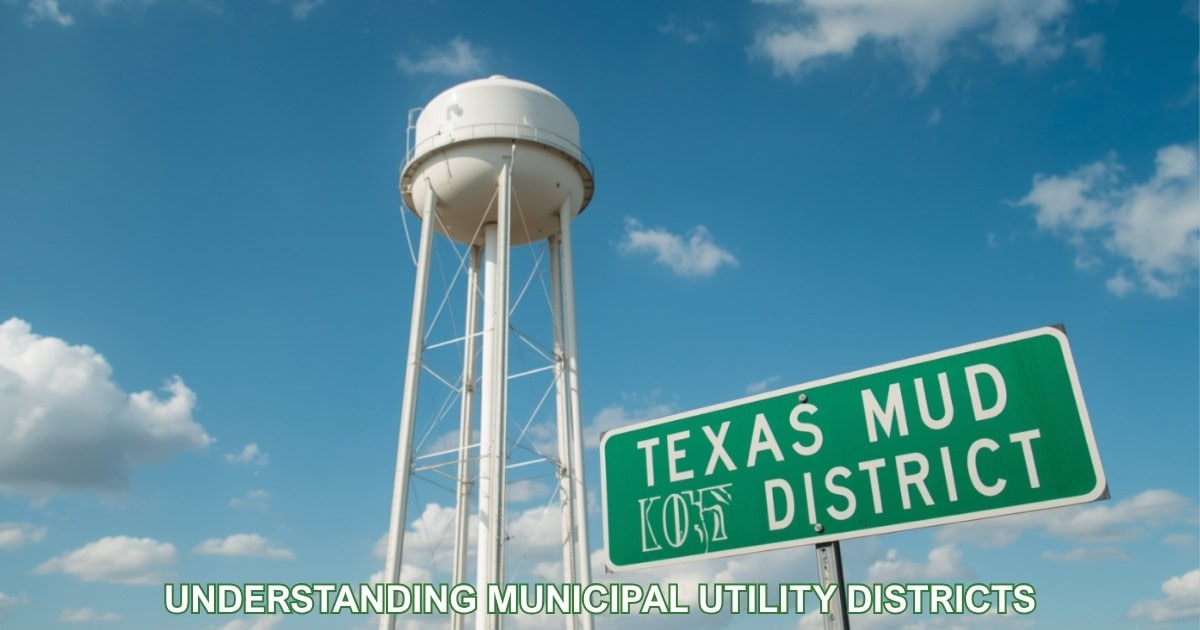
You’ve found the right house in the Houston area, you’re going through the numbers, and there it is on the tax statement: a “MUD tax.” MUDs are common across the Houston suburbs, so if you’re buying in Cypress, Katy, or Hockley you’ll run into Municipal Utility Districts constantly, and it helps to know in plain English what a MUD district is and what it means for your wallet.
What a MUD actually is
A MUD — Municipal Utility District — is a special local government district that finances and operates the water, sewer, and drainage systems for an area that sits outside a city’s utility service. Most of the master-planned communities ringing Houston are built on MUDs, because that’s how the roads, pipes, and detention ponds get paid for before a single family moves in.
Why they exist
When a developer builds a new community out in unincorporated Harris, Fort Bend, or Montgomery County, somebody has to pay for the infrastructure. The MUD issues bonds to fund it, and those bonds are paid back over time through property taxes on the homes in the district. In other words, the MUD tax on your bill is largely repaying the cost of the water and drainage system your neighborhood runs on.
What is MUD tax?
MUD tax is the property-tax rate a Municipal Utility District charges on the homes it serves, levied per $100 of assessed value, to repay the bonds that built the community’s water, sewer, and drainage and to fund the district’s ongoing operations. It is a separate taxing unit that stacks on top of your county and school-district rates, it appears as its own line on the property’s tax statement and on the county appraisal-district record, and the district’s board sets the rate each year.
What it means for your tax bill
Your total property tax rate is a stack of separate rates — county, school district, and so on — and in a MUD community the MUD’s rate is added on top. That’s why two similar homes can have noticeably different tax bills: one may be in a MUD and the other not, or they may be in MUDs at different stages. Newer districts often carry higher rates while the bonds are fresh, and those rates tend to come down as the district matures and pays its debt off. What matters for you is the total tax rate, because it directly affects your monthly payment and how much home you qualify for.
So how much is MUD tax in Texas? There’s no single number, because the MUD line is set district by district and the combined rate depends on how far along the district is in paying off its bonds. Across the Houston-area communities I document, combined property-tax rates for 2025–2026 run from roughly 2.0% to 2.6% of appraised value in older, debt-retired communities to roughly 3.0% to 3.7% in the newest MUD communities. In established Cypress neighborhoods like Longwood Village (around 2.22%), Coles Crossing (near 2.5%), and Fairfield (about 2.4% to 2.6%), the bonds are largely paid down and the rate is low; in newer Hockley communities like Dellrose (near 3.09%, on Harris County MUD 319) the bonds are young and the combined rate runs higher, with the newest sections reaching 3.2% to 3.7%. These rates are tax-year-specific and vary by address, so confirm the adopted rate for the exact parcel before you rely on it, and remember that filing your Texas homestead exemption lowers the school and county lines more than it lowers the MUD line.
Is a MUD a bad thing?
Not at all. It’s simply how suburban Houston gets built. Without MUDs, most of the communities people love in Cypress and Katy wouldn’t exist. The key is to know the rate going in and budget for it, rather than being surprised at closing. I make sure every buyer I work with understands the full tax picture before they write an offer.
A MUD is not an HOA
People mix these up all the time. Your HOA handles amenities, common areas, and deed restrictions, and you pay it dues directly. Your MUD handles utilities and infrastructure, and you pay it through property taxes. Many communities have both, and they’re separate things doing separate jobs.
How to check a home’s MUD rate
The MUD rate shows up on the property’s tax statement and on the county appraisal district’s record for the address — for example, the Harris Central Appraisal District lets you look up the taxing units for any Harris County address, and the Texas Comptroller keeps public financial and tax reports for the state’s special-purpose districts. Many MUDs also post their rate and financials on their own websites. Because the district is set by the parcel rather than the neighborhood name, I check it at the address level on every home, the same address-level check behind my Cypress and Katy guides. When we’re looking at homes together, I’ll pull the full tax breakdown so you see exactly what you’d be paying and can fold it into your financing.
The MUD notice you sign when buying a home in Texas
Texas law doesn’t leave the MUD a surprise at closing. Under Section 49.452 of the Texas Water Code, the seller must give you a written Notice to Purchaser before the sale contract becomes binding, and you sign to acknowledge you received it. The notice names the district, states its current tax rate per $100 of assessed value, and lists the bonds the district has issued, so it is the cleanest confirmation of exactly which MUD serves the home and what it charges. On a standard Texas resale, that notice is TREC form 59-0 (Texas REALTORS® form TXR 1420); when the district publishes its own version, that one is used instead. Read it before you sign, and treat it as a good moment to ask what the rate was a few years ago and which direction it is moving.
I’m Kevan Pewitt, a REALTOR® and a licensed Texas real estate broker, and I’ve helped Houston-area buyers weigh the MUD line on a home since 1989. Want help making sense of the numbers on a specific home? Start on the home-buying page or reach out anytime.
MUD districts: quick answers
What is a MUD district?
A MUD district is a Municipal Utility District — a special local government district that finances and operates the water, sewer, and drainage systems for an area outside a city’s utility service. Most of the master-planned communities around Houston are built on MUDs, which issue bonds to pay for that infrastructure and repay them through property taxes on the homes in the district.
What does MUD district mean?
MUD stands for Municipal Utility District. It’s a taxing district created to build and run a community’s utilities and drainage, and it appears as its own line, separate from your county and school-district taxes, on the property’s tax bill and appraisal-district record.
What is MUD tax?
MUD tax is the property-tax rate a Municipal Utility District charges on the homes it serves, levied per $100 of assessed value, to repay the bonds that built the community’s water, sewer, and drainage and to fund the district’s operations. It’s a separate taxing unit that stacks on top of your county and school-district rates.
How much is MUD tax in Texas?
There’s no single rate, because it’s set district by district. Across the Houston-area communities I document, combined property-tax rates for 2025–2026 run from about 2.0% to 2.6% of appraised value in older, debt-retired communities up to roughly 3.0% to 3.7% in the newest MUD communities. The rate is tax-year-specific and varies by address, so pull the adopted rate for the exact parcel before you rely on it.
Is a MUD the same as an HOA?
No. A MUD is a government taxing district that handles utilities and drainage and is paid through your property taxes; an HOA is a private association that handles amenities, common areas, and deed restrictions and is paid through dues you send directly. Many Houston communities have both, doing separate jobs.
Do MUD taxes ever go away?
The MUD rate typically falls over time as the district pays down its construction bonds, so an older, debt-retired community usually carries a lower MUD line than a brand-new one. It rarely disappears entirely, because the district still funds ongoing operations, but the rate generally declines as the district matures.
How do I find out if a home is in a MUD?
Look up the property on the county appraisal district’s record; in Harris County, HCAD lists the taxing units for any address, and the home’s tax statement itemizes each district. Many MUDs also post their rate and financials on their own websites, and Texas law requires that you receive a written notice of the district before your contract is final.
What is the MUD notice when buying a home in Texas?
It’s the written Notice to Purchaser that Section 49.452 of the Texas Water Code requires the seller to give you before the contract is binding; you sign to acknowledge you received it. It states the district’s name, its current tax rate per $100 of assessed value, and its bonds, and on a standard resale it’s TREC form 59-0 (or the district’s own published form).
Questions about taxes on a Houston home?
I’ll walk you through the full tax picture — MUD, county, and school — so there are no surprises. No pressure, no obligation.
Schedule a Free Consultation
Call or Text (281) 500-7077
Kevan Pewitt · REALTOR® & Broker · Houston Prime Realty
Last updated: September 2026 · This is general educational information on Texas MUD districts for Houston-area home buyers, not tax or legal advice; confirm current rates for any specific property.
More on this topic: buying a home in Houston →
