


In Texas, the washer, dryer and refrigerator do not come with the house unless the contract says so. The purchase contract lists what stays, and that list is built-in and attached items, so a free-standing appliance that simply plugs in belongs to the seller until the buyer writes it into the deal on a Non-Realty Items Addendum. The same contract gives the seller a line for keeping something that would otherwise stay, and that line has to be filled in before the contract is signed.
In plain terms: if it is built in, attached, or named on the contract’s own list, it stays with the house. If it rolls, unplugs, or lifts off a hook, it goes with the seller unless the buyer asks for it in writing on the Non-Realty Items Addendum. If the seller wants to keep something that would otherwise stay, the seller lists it as an exclusion in Paragraph 2D before the offer is accepted.
I hear this question from both sides of a Houston-area sale. A buyer walks through a house in Cypress, sees a refrigerator in every listing photo, and assumes it is part of the price. A seller in Katy plans to take the washer and dryer to the new house and is surprised the buyer expected them. Both are reasonable assumptions, and both can be settled in two minutes before an offer is written. Here is what the contract says, where the free-standing appliances fall, and how each side gets what it wants in writing.
What the Texas contract says stays with the house
The One to Four Family Residential Contract (Resale), TREC form 20-19, is the contract most Houston resales are written on. Paragraph 2 defines what is being sold, and it does that in three parts. The Land is Paragraph 2A, the lot and the address. The Improvements are Paragraph 2B, and the Accessories are Paragraph 2C. Together they are the Property. The contract puts it this way:
“PROPERTY: The land, improvements and accessories are collectively referred to as the Property (Property).” (TREC 20-19, Paragraph 2)
Paragraph 2B is where most of the surprises live. It covers the house and the garage, and then it names the permanently installed and built-in items that come along with them:
“IMPROVEMENTS: The house, garage and all other fixtures and improvements attached to the above-described real property, including without limitation, the following permanently installed and built-in items, if any: all equipment and appliances, valances, screens, shutters, awnings, wall-to-wall carpeting, mirrors, ceiling fans, attic fans, mail boxes, television antennas, mounts and brackets for televisions and speakers, heating and air-conditioning units, security and fire detection equipment, wiring, plumbing and lighting fixtures, chandeliers, water softener system, kitchen equipment, garage door openers, cleaning equipment, shrubbery, landscaping, outdoor cooking equipment, generators, and all other property attached to the above described real property.” (TREC 20-19, Paragraph 2B)
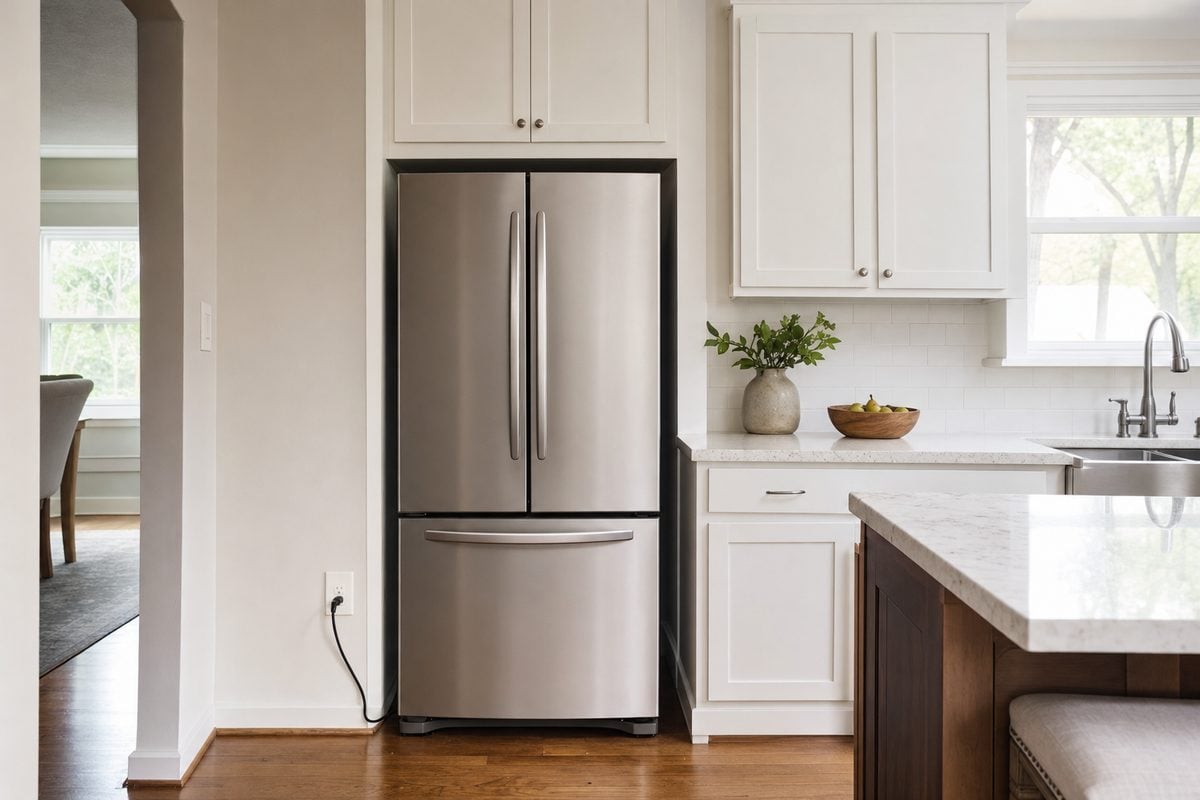
Read the first line of that list carefully. It says “all equipment and appliances,” but the words in front of it are “permanently installed and built-in.” A built-in oven, a cooktop set into the counter, a dishwasher plumbed under it, and a built-in microwave are improvements. A refrigerator standing in an alcove with a cord to the wall is not, even though it is an appliance. That one qualifier is the whole answer to the fridge question.
Paragraph 2C adds the accessories, which are things that are not attached but travel with the house anyway:
“ACCESSORIES: The following described related accessories, if any: window air conditioning units, stove, fireplace screens, curtains and rods, blinds, window shades, draperies and rods, door keys, mailbox keys, above ground pool, swimming pool equipment and maintenance accessories, artificial fireplace logs, security systems that are not fixtures, and controls for: (i) garage doors, (ii) entry gates, and (iii) other improvements and accessories. ‘Controls’ includes Seller’s transferable rights to the (i) software and applications used to access and control improvements or accessories, and (ii) hardware used solely to control improvements or accessories.” (TREC 20-19, Paragraph 2C)
Notice what made the accessories list: the stove, the curtains and their rods, the blinds, the above-ground pool, the pool equipment, the keys, and the remotes. A free-standing stove stays because the contract names it. A free-standing refrigerator is not named anywhere, so it does not.
The items people get wrong, in both directions
These are the ones that come up at my closing table more than any others. A quick summary of the common mix-ups:
- The mounted TV and its mount. The mount and bracket are listed in 2B and stay. The television that hangs on it is personal property and goes with the seller unless the buyer asks for it.
- Curtains and rods. Both are accessories under 2C and stay. Sellers who want to take a set of custom drapes have to exclude them in writing.
- The above-ground pool. Listed in 2C, so it stays, along with the pool equipment and maintenance accessories.
- The water softener. A water softener system is an improvement under 2B and stays, unless it is leased rather than owned, which I cover below.
- Garage door openers, gate remotes, and keys. The openers are in 2B, the controls and keys are in 2C, and the contract says “controls” includes the seller’s transferable rights to the apps and software that run them.
- The generator. New in 2026: permanently installed generators were added to the 2B list, so a standby unit on its own pad and wired into the panel now conveys. A portable generator on wheels is still personal property. I covered that change in my post on the 2026 Texas contract changes.
Paragraph 10B, titled Smart Devices, requires the seller at possession to hand over the access codes, usernames, passwords and applications the buyer needs for any smart device that runs the Property, the items on a Non-Realty Items Addendum, or a fixture lease the buyer takes over, and to remove the seller’s own phones and computers from those connections. So the smart thermostat stays, and so does the login that runs it.
What the contract does not say stays
Anything that is not land, not attached, and not on the 2B or 2C lists is personal property, and personal property is not part of the sale unless the parties add it. In a typical Houston resale that means the refrigerator, the washer and dryer, the freezer in the garage, the furniture, the grill on wheels under the patio cover, the playset that is not anchored into the ground, the potted plants on the porch, and the portable generator. A seller can take every one of those and be fully within the contract.
When a buyer expected one of those items and did not get it, the argument is usually “it was in the listing photos” or “the MLS remarks said appliances included.” Neither one is the contract, and the contract says so directly:
“AGREEMENT OF PARTIES: This contract contains the entire agreement of the parties and cannot be changed except by their written agreement.” (TREC 20-19, Paragraph 22)
Listing photos show the house as it was furnished on photo day. MLS remarks are marketing written by the listing side, and they can be wrong or out of date. If a buyer wants the refrigerator from the photos, the place to say so is the offer, and the way to say it is the Non-Realty Items Addendum.
People sometimes fold this question into the Seller’s Disclosure Notice, and the two are different documents doing different jobs. The disclosure is about the condition of what is being sold, and I explain it in Do You Have to Disclose That? What conveys is a question about which items are being sold, and Paragraph 2 and the addenda answer it.
What is a non-realty items addendum?
The Non-Realty Items Addendum is the TREC form that adds personal property to a residential sale. It is TREC form 57-0, published for voluntary use and dated October 10, 2011, and Texas REALTORS® carries it as TXR 1924. It is a single page with three paragraphs, and it is listed by name in Paragraph 22 of the contract under the addenda that can be made part of the agreement. When a buyer wants the refrigerator, the washer and dryer, the mounted television, or the patio furniture, this is the form that does it.
Paragraph A is the working part of the form:
“For an additional sum of $____ and other and good valuable consideration, Seller shall convey to Buyer at closing the following personal property (specify each item carefully, include description, model numbers, serial numbers, location, and other information):” (TREC 57-0, Paragraph A)
Follow the form’s own instruction to the letter. “The refrigerator” is a weaker description than “the stainless LG French-door refrigerator in the kitchen, model and serial number as listed,” because the second version leaves no room to swap in the older unit from the garage before closing. Describe each item carefully, note where it sits in the house, and include the model and serial numbers when you can read them.
Paragraphs B and C protect each side in one sentence apiece:
“B. Seller represents and warrants that Seller owns the personal property described in Paragraph A free and clear of all encumbrances. C. Seller does not warrant or guarantee the condition or future performance of the personal property conveyed by this document.” (TREC 57-0, Paragraphs B and C)
Paragraph B has the seller promise that each item is owned outright, so a seller who conveys a refrigerator that is still being paid off under a store financing plan is in breach of that warranty. Paragraph C means the buyer takes the appliance as it is. If the washer quits a month after closing, the addendum does not make the seller responsible for it.
The dollar line and the lender
Paragraph A has a blank for an additional sum, and on most of the Non-Realty Items Addendum forms I see the blank is filled in at zero, with the appliances treated as part of the overall bargain. The reason is the loan. A mortgage lender is lending against the real property, and the appraisal values the real property, so personal property on an addendum is generally carried at no value in the transaction, and it is not added to the price the lender is financing. Speaking as someone who appraises homes as well as sells them, I would not expect a refrigerator to move an appraised value. If you are paying cash the dollar line can read whatever the two of you agree, and if you are financing, ask your lender how it wants the addendum handled before you write it.
When the addendum gets attached
The Non-Realty Items Addendum is part of the written agreement, so it goes in with the contract the buyer signs, and the seller accepts or counters the items along with the price and the closing date. Trying to add the refrigerator after the contract is executed means asking the seller for an amendment, and at that point the seller is free to say no. The appliance question is cheapest to ask before anyone has signed anything.
How sellers keep the chandelier
The contract gives the seller one line for keeping an improvement or an accessory that would otherwise stay, and it is Paragraph 2D:
“EXCLUSIONS: The following improvements and accessories will be retained by Seller and must be removed prior to delivery of possession:” (TREC 20-19, Paragraph 2D)
The exclusion has to be written into the contract, which means it has to be in place before the contract is signed. And the item has to be removed before possession, so a seller who excludes the dining room chandelier is agreeing to take it down before the buyer gets the keys. The contract stops there; hanging a plain fixture in its place so nothing is left dangling is good practice, and it is what I ask my sellers to do. Once a contract is executed without the exclusion, the chandelier is part of the Property and the seller needs the buyer’s written agreement to take it.
In practice the exclusion starts earlier than the contract. The Texas REALTORS® listing agreement, TXR 1101, carries the same Paragraph 2 structure, with its own exclusions line at 2D, and that is where I ask a seller the question before the photographer comes. If there is a light fixture, a mirror, a set of drapes, a mounted television, or a water softener you intend to keep, it goes on the listing paperwork, then into the MLS remarks, and then onto the contract’s 2D when the offer comes in. My practical rule for sellers is simple: if you would hate to lose it, take it down before the first showing and replace it with something ordinary. That way the fixture never shows up in a photo or an offer, and the question never comes up.
Leased fixtures: solar panels, water softeners, propane tanks and security systems
Some items that look like improvements are not owned by the seller at all. Paragraph 4B of the contract covers that case and names the common ones: “solar panels, propane tanks, water softener, security system.” When any of those are leased, the contract calls for the Addendum Regarding Fixture Leases, TREC form 52-1, and that addendum describes the situation plainly:
“Leased Fixtures are those fixtures in or on the Property that Seller leases and does not own” and “All rights to the Leased Fixtures are governed by Fixture Leases.” (TREC 52-1, Paragraph A)
The point for a buyer is that a leased solar array on the roof is not something you are buying. Under the addendum the buyer either assumes the lease at closing and takes over the payments, or the addendum states whether the seller will remove the leased fixture before closing, repairing any damage the removal causes. The addendum also gives a buyer who has not yet seen the lease paperwork a window to review it: the seller provides the leases within 5 days after the Effective Date, and the buyer may terminate within 7 days after receiving them. On a Houston house with panels, I ask for the lease before the offer is written, because the monthly payment and the remaining term change what the house really costs.
What happens when it is missing on walk-through day
Most conveyance problems surface at the final walk-through, when the buyer notices the curtain rods are gone or the refrigerator from the addendum has been swapped. The walk-through itself is documented on the Texas REALTORS® Buyer’s Walk-Through, Confirmation, and Acceptance Form, TXR-1925, and its opening notice explains why the walk-through exists:
“NOTICE TO BUYER: The contract provides that the Seller will deliver possession of the Property to the Buyer in its present or required condition, ordinary wear and tear excepted. Before closing, the Buyer should verify that the condition of the Property meets the terms of the contract.” (TXR-1925)
“Meets the terms of the contract” includes Paragraph 2 and any Non-Realty Items Addendum. If something that was supposed to stay is gone, the first step is a phone call between the two real estate agents, and in my experience that resolves most of these the same day. Sometimes the seller’s movers took the rods by mistake and they come back. Sometimes the seller forgot an item was on the list and agrees to return it or credit it. When a quick fix is not possible before closing, the parties can agree to hold money back at the title company, which I explain in my post on the escrow holdback.
When the two sides cannot agree, the contract’s default and remedy provisions in Paragraph 15 apply, and the earnest money can come into play. I walk through those remedies in my post on the release of earnest money in Texas, so I will not restate them here. The short version is that a missing refrigerator is rarely worth a dispute, and the reason to write the addendum carefully is so the conversation never gets that far.
How I handle what conveys for buyers and sellers
For my buyer clients, the appliance question gets asked before the offer is written. If you want the refrigerator, the washer and dryer, or the mounted television, we put each one on the Non-Realty Items Addendum with its description and location, and the addendum goes in with the offer so the seller is answering one complete package. If the house has solar panels, a water softener, or a security system, I ask the listing side whether any of it is leased before we write, so the Fixture Leases addendum is in the offer if it needs to be. At the walk-through we check the condition of the house and every item on that list.
For my seller clients, the exclusions conversation happens at the listing appointment, following the path I described above, so nothing you intend to keep ever reaches a buyer’s offer. When a buyer asks for the refrigerator on an addendum, we treat it as one more negotiable term, the same as the closing date or a repair request.
Whoever you work with, these are fair questions to ask any real estate agent before you sign, and you should get a straight answer to each one: What on this house is built in and what is free-standing? Is anything leased? What is the seller excluding? And if I want an item that is not on the contract’s list, how and when do we ask for it? A real estate agent who handles Paragraph 2 well will have the answers before you do. My guide on how to choose a Realtor covers the rest of what to look for, and for buyers, compensation for that representation is set out in a written buyer representation agreement before showings begin, which I explain in who pays the real estate buyer’s agent in Texas.
If you are getting ready to buy, my home-buying guide walks through the offer from the first showing to the closing table, and if you are selling, my guide for home sellers covers the listing paperwork where the exclusions start.
What conveys with a Texas home: your questions answered
Does the refrigerator come with the house in Texas?
Not automatically. The TREC contract’s Paragraph 2B conveys permanently installed and built-in appliances, and Paragraph 2C names the stove, but a free-standing refrigerator is on neither list. It stays with the seller unless the buyer writes it into the offer on the Non-Realty Items Addendum and the seller agrees.
Are the washer and dryer included when you buy a house in Texas?
No, not unless the contract says so. A washer and dryer that plug in and hook to the wall are personal property under the Texas contract. The buyer asks for them on the Non-Realty Items Addendum, and once the seller signs, the seller conveys them at closing with no warranty of their condition or future performance.
What is a non-realty items addendum?
It is TREC form 57-0, also carried as Texas REALTORS® form TXR 1924, a one-page addendum that adds personal property to a Texas home sale. Paragraph A lists each item with its description, model and serial numbers and location; Paragraph B has the seller warrant that the items are owned free and clear; Paragraph C says the seller does not warrant their condition or future performance.
Can the seller take the light fixtures?
Only if the contract excludes them. Lighting fixtures and chandeliers are improvements under Paragraph 2B, so they stay with the house unless the seller lists them in Paragraph 2D, Exclusions, before the contract is signed. An excluded fixture has to be removed before the seller delivers possession.
Do curtains stay with the house in Texas?
Yes. Curtains and rods, blinds, window shades, and draperies and rods are all named as accessories in Paragraph 2C of the TREC contract, so they convey with the house. A seller who wants to keep a set of custom drapes has to exclude them in writing in Paragraph 2D.
What if the seller took something that was supposed to stay?
Raise it at the final walk-through, before closing, and let the real estate agents talk. Most of these are fixed with the item returned, a credit, or money held back at the title company by agreement. If the two sides cannot agree, the contract’s default provisions in Paragraph 15 apply, and the earnest money can be part of that outcome.
Want the fridge, or want to keep the chandelier?
Buying or selling in the Houston area, from Cypress to Katy, and want to talk through what conveys before anything is signed? I’m glad to walk through it with you. There’s no pressure and no obligation.
Schedule a Consultation
Call or Text (281) 500-7077
Kevan Pewitt · REALTOR® & Broker · Houston Prime Realty
Last updated: October 2026 · Reflects the TREC One to Four Family Residential Contract (Resale) 20-19 (mandatory July 1, 2026), Paragraphs 2, 4B, 10B, 15 and 22; the TREC Non-Realty Items Addendum 57-0 (TXR 1924); the TREC Addendum Regarding Fixture Leases 52-1; and Texas REALTORS® forms TXR 1101 and TXR-1925. All contract forms are on TREC’s contract forms page. General information, not legal advice; for your own contract, talk to the title company or a Texas real estate attorney.
More on this topic: contracts, offers, and closing in Texas →
