



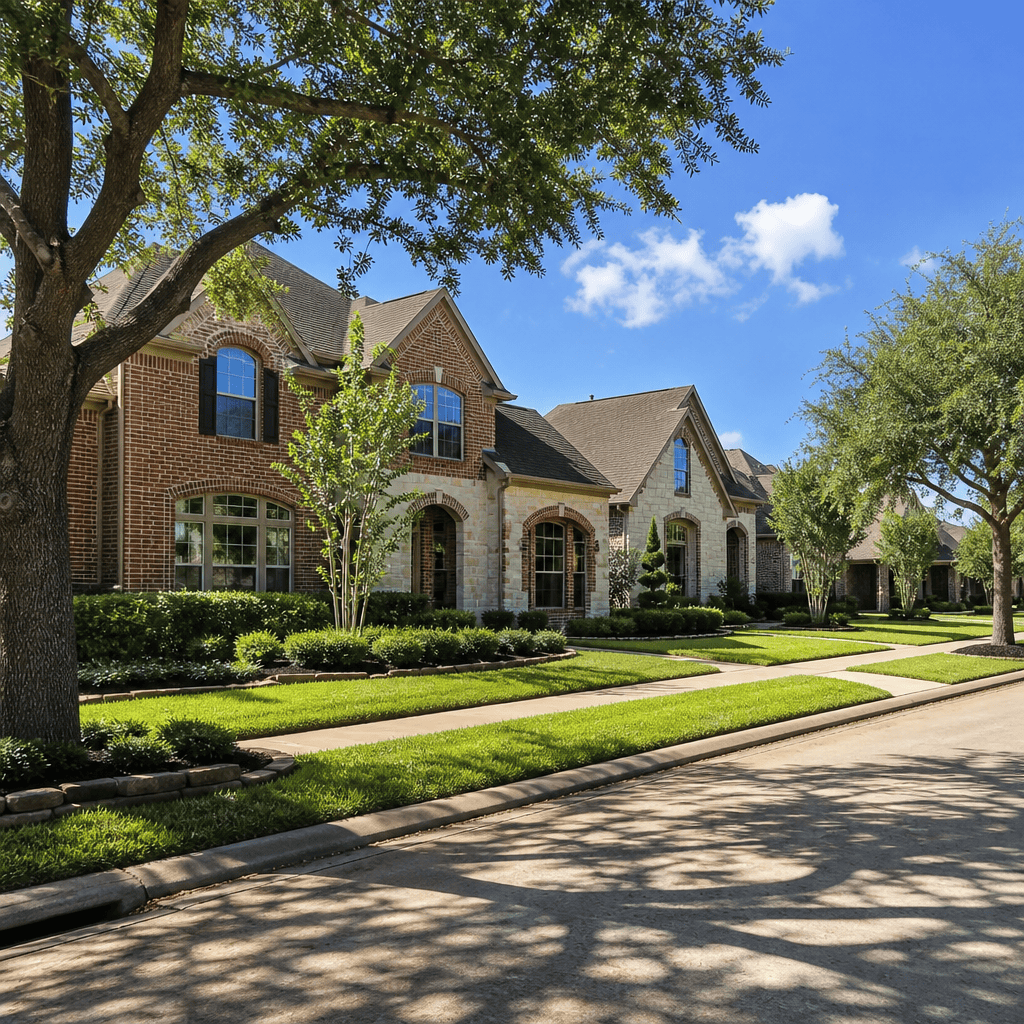
Moving to Houston from out of state means buying a home in a metro that plays by rules most of the country has never heard of: there is no zoning, the property tax rate changes from one subdivision to the next, the flood map tells you less than you’d think, and school assignments ignore city limits entirely. None of that should scare you off. The median single-family home in the Houston area sold for about $340,000 in July 2026, per the Houston Association of REALTORS®, and buyers relocating from higher-cost metros often find their budget reaches much further here. You just need to understand a few Houston-specific things before you pick an area, because you won’t have years of local knowledge to lean on. I’m Kevan Pewitt, broker-owner of Houston Prime Realty, a REALTOR®, and a licensed Texas real estate broker since 1989. A large share of my relocation clients choose their neighborhood before they ever set foot in it, so this is the conversation I have with every one of them first.
What to know before moving to Houston
These are the five things that most often surprise buyers moving to Houston from another state:
- No zoning. Deed restrictions do the work a zoning map does elsewhere, and protection varies block to block.
- MUD taxes. Combined property tax rates commonly run between 2% and 3.5% of assessed value depending on the district, which can put similar homes thousands of dollars a year apart.
- Flood history. Check the FEMA map for the exact lot, then ask about the home’s actual history. Many Houston homes that have flooded sit outside the mapped high-risk zones.
- School lines. District boundaries ignore city limits. A single community can zone to two school districts, and most Katy addresses sit outside the City of Katy.
- Distance buying. Video tours, a licensed inspection, and the Texas option period make an out-of-state purchase workable, with your real estate agent doing the on-the-ground work.
The rest of this guide walks through each one, plus how to actually choose your corner of a metro this large. If you want the buying process itself laid out step by step, my first-time home buyer’s roadmap for Houston covers that ground; this post is about the parts of moving to Houston you’d otherwise have no way to know.
Houston has no zoning — what that actually means on your street
Houston is the largest city in the country without a conventional zoning code. Voters turned zoning down three separate times, most recently in 1993, and the city has operated without it ever since. That doesn’t mean anything goes. What replaces zoning is a patchwork: deed restrictions recorded against individual subdivisions, city ordinances covering things like setbacks and historic districts, and the plain economics of land.
The practical effect is that protection varies street by street. Inside a deed-restricted subdivision — and nearly every master-planned community in Cypress, Katy, and the wider suburbs is one — the rules about what can be built around you are often stricter than zoning would be. Outside those restrictions, especially in closer-in Houston neighborhoods, a townhome row, a bar, or a small warehouse can legally sit at the end of a single-family block. Neither situation is hidden; you simply have to look for it, because no color-coded zoning map will do it for you.
So when you’re comparing areas from three states away, look past the house itself. Ask what the deed restrictions cover and who enforces them, and pay attention to undeveloped land nearby, since an empty tract in an unrestricted area could become nearly anything. When I walk a home on video for a relocating buyer, I always show what’s behind the back fence and what sits at both ends of the street. In Houston, that context is doing the job zoning does in the city you’re leaving.
MUD districts: why two similar homes carry very different tax bills
Texas has no state income tax, so local services ride on property taxes, and in the Houston suburbs the total rate depends heavily on whether a home sits in a municipal utility district. A MUD is a small taxing district created to finance the water, sewer, and drainage infrastructure for a new community; it repays those construction bonds through its own line on the property tax bill. Nearly every newer master-planned community around Cypress and Katy has one. I’ve written a plain-English explainer on what a MUD district is and how it affects your taxes if you want the mechanics.
Here’s why it matters when you’re choosing between areas. The combined rate on a Houston-area home — county, school district, MUD, emergency services, and the rest — commonly lands between roughly 2% and 3.5% of assessed value. On a $400,000 home, a 2.1% combined rate is about $8,400 a year while a 3.2% rate is about $12,800. That’s similar houses, similar price, roughly $370 a month apart, and buyers moving to Houston from a low-property-tax state feel that difference immediately. As a general pattern, older neighborhoods whose bonds are paid down carry lower rates, and brand-new communities still building infrastructure carry the higher ones, often easing downward over the years as debt retires.
Before you get attached to any listing, look up the address on the Harris County Appraisal District site (or the appraisal district for whichever county the home is in) and see every taxing unit that touches the parcel. Then read my post on how Texas property taxes flow into your monthly mortgage payment, because your lender will escrow these numbers and they shape what you can afford as surely as the interest rate does. A Texas homestead exemption softens the bill on your primary residence, but it won’t close a gap that size between two districts. Rates change year to year and vary by address, so verify current figures for any home you’re serious about; none of this is tax advice.
Flood zones and flood history are two different questions
FEMA’s flood maps show modeled risk going forward. They say nothing about whether a particular house has already taken on water, and in Houston you need both answers.
When a listing says “not in a flood zone,” it usually means the home sits outside the mapped 100-year floodplain, the area with a 1% chance of flooding in any given year. Plenty of Houston homes outside that line have flooded anyway; after Hurricane Harvey in 2017, most of the flooded homes in the Houston area were outside the mapped high-risk zones. The map is a starting point, and I treat it as exactly that.
On any home you’re considering, start by looking up the exact lot on the FEMA Flood Map Service Center. Flood zones here can change within a single subdivision, so check the address, never the neighborhood name. Then ask about history. The Texas seller’s disclosure now asks pointed questions about past flooding, reservoir flood pools, and flood insurance claims, and I’ve mapped out Houston’s flood disclosure questions so you know what each one is really asking. I also encourage buyers moving to Houston to price flood insurance even outside the high-risk zones; there it’s usually inexpensive, and after 2017 I consider it cheap peace of mind anywhere in this region.
School boundaries ignore city limits
In Texas, independent school districts draw their own attendance boundaries, and those lines pay no attention to what city an address belongs to. That trips up families moving to Houston more than almost anything else, so here is what it looks like in my core area.
Bridgeland, a master-planned community in Cypress, zones most of its sections to Cy-Fair ISD schools, while its newest sections zone to Waller ISD. One community, one developer, two school districts. And most homes with a Katy mailing address are not in the City of Katy at all; Katy ISD sprawls across parts of Harris, Fort Bend, and Waller counties, and south of Katy proper some homes with Katy addresses zone to Lamar CISD instead. The city name on a listing only tells you where the post office routes the mail.
If a specific school matters to your family, verify the campus assignment for the exact address on txschools.gov and confirm it with the district itself before you write an offer. These communities are growing fast, and attendance boundaries get redrawn as new campuses open. I flag the zoning on every home my buyers shortlist, because I’ve watched the assignment change between a family’s first search and their closing.
Drive the commute at the hour you’d actually drive it
The nine-county Houston metro covers more land than the state of New Jersey, and commute time is the price of all that affordable space. A test drive from Cypress to downtown on a Saturday afternoon might take 35 minutes; the same drive at 7:30 on a Tuesday morning can take an hour or more.
Before you commit to an area, run the commute at your real hour, in the real direction, both ways — in person if you can visit, or with the depart-at feature in your maps app if you can’t. The corridors that matter most for my buyers are I-10 west toward Katy, US-290 toward Cypress, and the Grand Parkway connecting the two; the tollways and METRO’s park-and-ride routes change the math for a lot of downtown and Medical Center commuters. It’s also fair to weigh the job itself. A hybrid schedule that sends you in twice a week makes the farther-out communities far easier to live with than a five-day drive would.
How to buy a Houston home when you can’t be here
Buying from several states away is routine now, and the Texas process protects a careful buyer better than most people relocating here expect. This is how I run it for clients moving to Houston from out of state.
Showings happen by live video, and a good remote tour covers more than the rooms: the street, the drainage, the slope of the yard, the road noise, and what’s on the other side of the fence. Once you’re under contract, a Texas home inspector — licensed by the Texas Real Estate Commission and working from a required reporting form — walks the house and delivers a written, photo-documented report covering the structure, roof, foundation, electrical, plumbing, and HVAC. In this climate I pay particular attention to the foundation notes, any evidence of past water intrusion, and the age of the roof and air conditioning, because those are the expensive surprises in Gulf Coast housing stock.
Your real protection is the option period: a negotiated number of days at the start of the contract during which you can terminate for any reason at all, in exchange for a modest negotiated fee. That window is what turns a sight-unseen offer into a decision you can unwind if the inspection changes your mind. I’ve explained how the Texas option period works in detail, including how the days are counted and what the fee buys you. Closing itself doesn’t require a plane ticket either; a mobile notary can bring the documents to you in whatever state you’re leaving.
Representation matters more, and earlier, when you’re buying at a distance. You can’t drive by the house on your lunch break, so you’re relying on your real estate agent’s eyes, local knowledge, and contractual duty to you. In Texas that relationship goes in writing before showings begin: my compensation is negotiated up front in a written buyer representation agreement, and in many transactions the seller still contributes toward the buyer’s real estate agent’s fee. If you’re starting from zero, the home-buying page explains how I work with buyers from first call to closing.
How I work with relocating buyers
Buying from another state means most of the on-the-ground work falls to your real estate agent, so here is what I handle for clients moving to Houston:
- Video tours with the full context. I walk each home live on video and show the street, the lot, the drainage, and what sits behind the fence, not just the rooms.
- School zoning per address. I verify the district and campus assignment for the exact address, because boundaries here ignore city limits and get redrawn as these communities grow.
- The whole tax picture. I pull the combined property tax rate, MUD and all, for every home you shortlist, so a low sticker price attached to a 3.2% rate doesn’t surprise you at closing.
- Option-period management. I line up a TREC-licensed inspection and track the option-period deadline, so a sight-unseen offer stays a decision you can walk back.
- Representation in writing. My role and compensation are set up front in a written buyer representation agreement, and in many sales the seller still contributes toward the buyer’s real estate agent’s fee.
None of that raises what you pay for the house; it means you can see and steer the purchase from a thousand miles away almost as well as if you were standing in the driveway.
Choosing your corner of the metro
Buyers moving to Houston usually arrive holding a list article that ranks the suburbs, and I’d set it down, because those lists can’t weigh your commute, your budget, your school priorities, or your tolerance for a 3.2% tax rate, and the metro is far too large to evaluate all at once. Decide on the trade-offs above first, then get to know two or three areas deeply.
My core service area is Greater Houston, Cypress, and Katy, and I maintain detailed guides on each so you can do that homework from wherever you live now. Start with the Houston area guide for the big picture, then go deeper with the Cypress community pages and my post on living in Cypress, or the Katy community pages and living in Katy. Each covers neighborhoods, price ranges, schools, and what daily life there is actually like, which is the local texture you can’t see when you’re moving to Houston from a distance.
Moving to Houston: questions relocating buyers ask me
Do I need a local real estate agent when moving to Houston?
Yes, and the case for one only gets stronger the farther away you are. At a distance you’re leaning on your real estate agent’s eyes and local knowledge instead of your own, so what that real estate agent actually does matters. Working with relocating buyers, I run live video tours that show the street, the lot, and what sits behind the fence, along with the rooms; I verify the school district and campus assignment for the exact address, since boundaries here ignore city limits; I pull the full combined tax rate, MUD included, for every home you shortlist; and I manage the option period so a sight-unseen offer stays a decision you can unwind. In Texas that relationship goes in writing before showings begin: my compensation is negotiated up front in a written buyer representation agreement, and in many sales the seller still contributes toward the buyer’s real estate agent’s fee. Moving from out of state, vet a real estate agent on exactly how they’ll cover your video tours, inspection, and option period. My guide on how to choose a realtor lays out what to look for.
Can I buy a house in Houston without seeing it in person?
Yes. Buyers moving to Houston do it every week. Live video tours, a TREC-licensed inspection with a written photo report, and the option period’s right to terminate give you real safeguards, and a mobile notary lets you close from your current state. The piece you can’t do remotely is judge the surroundings, which is why I show the street and the lot context on every video tour along with the rooms.
Why does Houston have no zoning?
Houston voters rejected zoning three times, most recently in 1993. Land use is governed instead by recorded deed restrictions, targeted city ordinances, and market economics. In deed-restricted subdivisions the practical protections are often stronger than zoning; in unrestricted areas, they can be close to nonexistent.
What is a MUD tax and will I pay one?
A municipal utility district taxes the homes it serves to repay the bonds that built the community’s water, sewer, and drainage systems. If you buy in a newer master-planned community around Houston, Cypress, or Katy, you’ll very likely pay one, and Texas law requires that you receive notice of the district and its rate before the contract is final. Combined rates including a MUD commonly reach 3% or more of assessed value, so always check the full rate for the specific address.
How do I find out if a Houston house has flooded before?
Read the seller’s disclosure carefully; Texas requires sellers to answer specific written questions about past flooding and flood insurance claims. Pair that with the FEMA flood map for the exact lot, and ask your real estate agent to check the home’s history and the neighborhood’s drainage record. Homes outside mapped flood zones have flooded here, so ask the history question every time.
Do homes with a Katy address sit inside the City of Katy?
Usually not. The City of Katy is small, and most homes with Katy mailing addresses lie outside its limits in unincorporated Harris, Fort Bend, or Waller County. School zoning follows district lines, so a Katy-address home may zone to Katy ISD or, in some southern sections, to Lamar CISD. Verify the district and campus for the exact address; the mailing city won’t tell you.
Start the conversation before you start packing
If moving to Houston is on your horizon, the best time to talk is months before the truck is loaded, while you can still choose an area with clear eyes. I’m glad to start with a no-pressure video call about areas, taxes, schools, and timing, and to set up listing alerts so you can watch your shortlisted neighborhoods from wherever you live today. Call or text me at (281) 500-7077, or reach out through the site to schedule a consultation. And if your move points toward Bryan–College Station, I serve that market as well.
Tax rates, school attendance boundaries, and flood maps all change over time. Verify current figures for any specific property; this post is general information, not legal or tax advice.
Last updated: September 2026
