


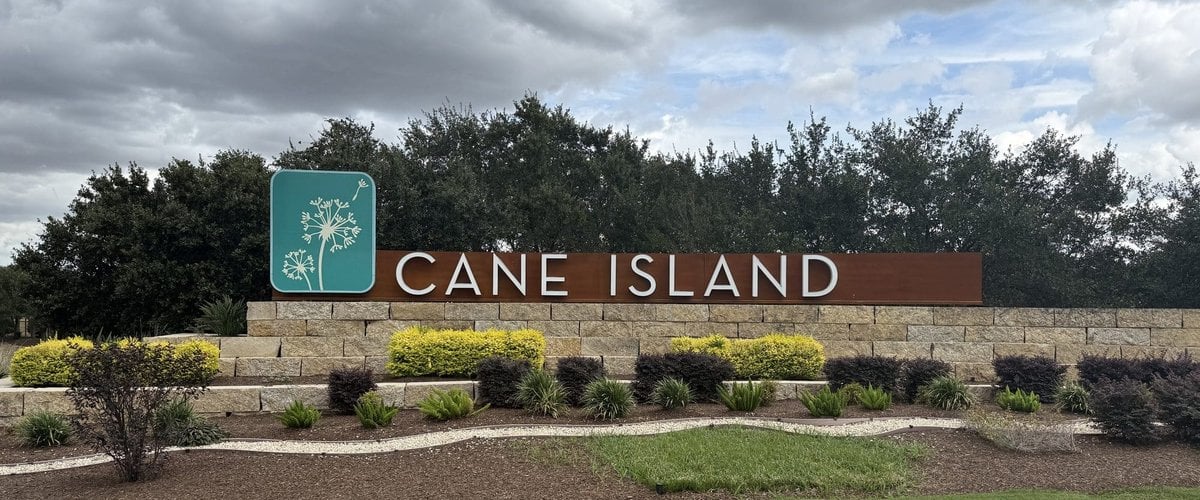
Cane Island Realtor — Your Local Guide to Cane Island, Katy TX 77493
I’m Kevan Pewitt, a REALTOR® and the broker-owner of Houston Prime Realty, licensed as a Texas real estate broker since 1989, and I work as a Cane Island Realtor for buyers and sellers on the west side of Katy. Cane Island is a master-planned community of about 2,100 homes on roughly 1,090 acres north of I-10, developed by Rise Communities beginning in 2015, and it is one of the few Katy-area master-planned communities that sits inside the City of Katy. That puts city water, sewer, trash, police, and fire behind every address, and a City of Katy line on the tax bill alongside a modest MUD rate, for a combined 2026 rate of about 3.04 percent. The community is built out and mostly resale now, with Robertson Elementary on site and Katy Junior High and Katy High beyond it. What follows comes from the Waller County appraisal records, Katy ISD’s own address-level school assignments, the MUD’s official statement, the HOA’s state filing, and the HAR MLS, so you can judge the fit yourself.
Cane Island at a Glance
| Location | West Katy, TX 77493, in Waller County and inside the City of Katy limits; north of I-10 and US-90, with its own I-10 interchange at Cane Island Parkway, about five miles west of the Grand Parkway |
| Community type | Master-planned, about 1,090 acres and roughly 2,100 homes in Sections 1–45 plus The Estates, a gated custom section; developer Rise Communities; first residents in 2015; amenity village Cane Quarter at 2100 Cane Island Parkway |
| Median price | $582,450 median sale price and $188 per square foot across the 84 homes sold from October 1, 2025 to October 1, 2026 (HAR MLS, pulled October 1, 2026, Lakes of Cane Island excluded); median 40 days on market |
| Price range | Closed sales over those 12 months ran from $350,000 to about $1.99 million; the 62 active listings on October 1, 2026 carried a median list price of $562,500 ($375,000 to $2.5 million) |
| Property tax | About 3.04% combined (2026 rates on the Waller CAD roll): Katy ISD 1.1171 + Waller County 0.5354 + Road & FM 0.0231 + Brookshire-Katy Drainage 0.0618 + City of Katy 0.4200 + Harris-Waller Counties MUD 3 0.8800, per $100 |
| HOA | Cane Island Community Association, managed by Inframark; dues reported around $1,320 a year in secondary sources, so confirm on the resale certificate. Closing-side fees on the state filing: $300 transfer, $1,200 capitalization, $350 resale certificate |
| Schools | Katy ISD (TEA 2026 B, 88) — Robertson Elementary A (92), on site → Katy Junior High A (90) → Katy High B (87); verify per address |
| New construction | Production building inside Cane Island is finished; custom homesites remain in The Estates. Active new construction under the Cane Island name is in Lakes of Cane Island, a separate development next door |
| Flood | Cane Island Branch watershed, west of and upstream from the Addicks and Barker reservoirs; drainage built around four systems and 25 detention ponds that double as the community’s lakes. No documented flooding of Cane Island homes was found; confirm the FEMA designation per lot |
| Best for | Buyers who want an established master-planned community with city services, an on-site A-rated elementary, and a full amenity village, in a resale market where buyers currently have room to negotiate |
Figures are point-in-time and vary by section and address — verify before relying. Not legal or tax advice.
Where Cane Island Is
Cane Island sits on the far west side of Katy, entirely north of I-10 and north of US-90 and the Union Pacific line, which form its southern edge. Cane Island Parkway is the community’s spine. It crosses I-10 at the community’s own interchange, opened in 2017, and continues south to FM 1463 through commercial land, but every home is on the north side of the highway. The amenity village and community address of record are at 2100 Cane Island Parkway. On the state’s water-district map, the boundary of Harris-Waller Counties MUD 3, which covers all 45 sections, runs from US-90 north to Morton Road, with Lakes of Cane Island across Morton Road to the north. For a specific lot, I confirm on the Waller County Appraisal District’s map.
The Grand Parkway at I-10 is about 5 miles east, roughly 10 minutes without traffic. Routing from 2100 Cane Island Parkway puts the Energy Corridor at I-10 and Eldridge about 14 miles and 21 minutes away, the Galleria about 27 miles and 38 minutes, Downtown about 31 miles and 41 minutes, and the Texas Medical Center about 33 miles and 47 minutes. Those are no-traffic times, and peak I-10 will run longer, so drive the route at the hour you would actually be driving it.
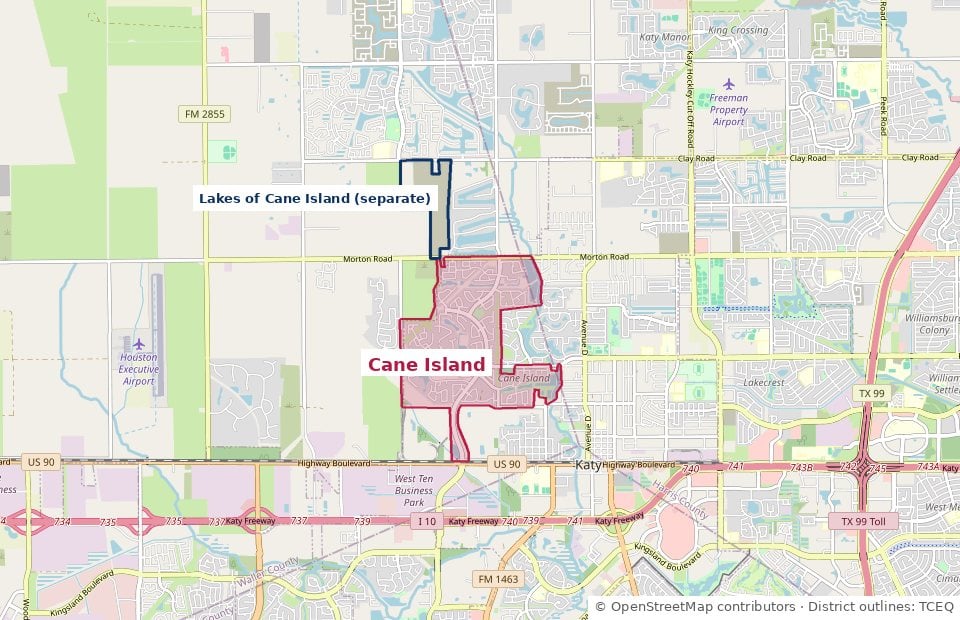
Cane Island’s outline is the boundary of Harris-Waller Counties MUD 3, which covers all 45 sections, from the Texas Commission on Environmental Quality’s water-district map; Lakes of Cane Island, outlined in navy, is a separate development. The outlines are approximate — confirm any specific parcel with the Waller County Appraisal District. Basemap © OpenStreetMap contributors.
Cane Island is not Lakes of Cane Island. Lakes of Cane Island is a separate 221.5-acre, 570-lot development across Morton Road to the north, running up toward Clay Road. It sits outside the city limits, has its own MUD (Waller County MUD 58, at $1.50 per $100), its own water company, its own HOA without access to Cane Quarter, and a different junior high and high school. Listing portals often tag it “Cane Island,” and an MLS search for Cane Island returns both: on October 1, 2026, 47 of the 109 active listings matching that search were in Lakes of Cane Island. A Cane Island home’s legal description on the Waller CAD record reads “Cane Island Sec” followed by the section number.
Why Being Inside the City of Katy Matters
The City of Katy annexed about 597 acres of Cane Island in November 2013, when Harris-Waller Counties MUD 3 was created, and another 400 acres in April 2015. MUD 3’s 2024 official statement describes the district as lying entirely within the city limits and covering all 45 sections. For a homeowner, that means one city utility account for water, sewer, and trash, City of Katy police and the Katy Fire Department for public safety, and no emergency services district line on the tax bill. The city adds 42 cents per $100 of value, and the MUD adds 88 cents. Together those two lines come to $1.30, which is still less than the $1.50 MUD rate that many newer Katy-area communities carry on its own.
The city also offers a 20 percent homestead exemption on its share of the tax. The name has history behind it as well. The City of Katy’s own history says the first settlement here, in 1872, was known as Cane Island for the creek that runs through it, and the town was renamed Katy in 1895. The community revives the original name.
The Feel of the Area
Cane Island is organized around water. The engineered lakes that carry the community’s drainage are also its scenery, with fountains, trail loops, and homes backing onto the banks. A fountain greets you at the main entry off Cane Island Parkway, and the trails connect the sections to Cane Quarter.
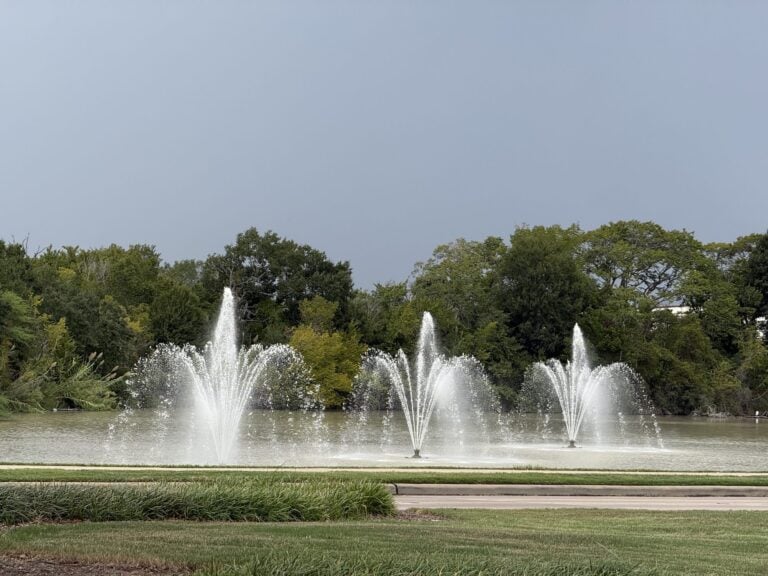
The fountain at the main entry off Cane Island Parkway.
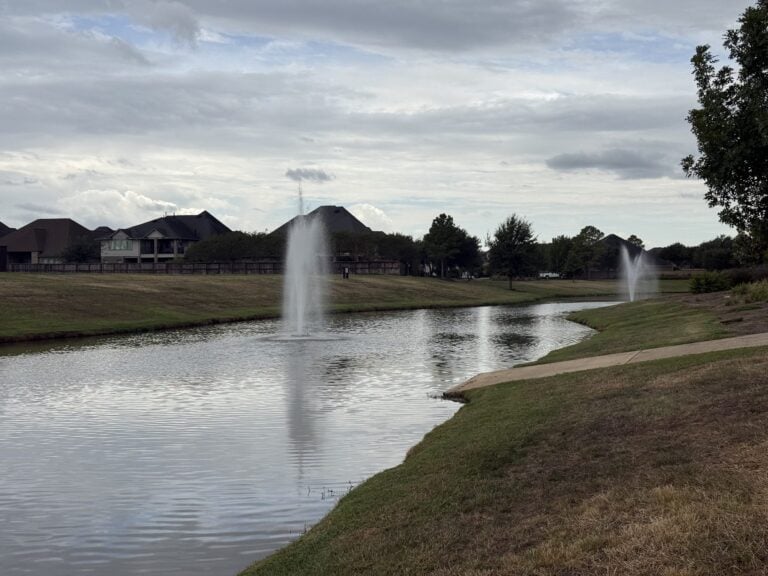
One of the detention lakes that double as amenity lakes.
Cane Quarter, the amenity village at 2100 Cane Island Parkway, holds most of the shared spaces: a resort pool with a splash pad and cabanas, a year-round lap pool, a two-story fitness center open around the clock with a yoga and spin studio, an event lawn, and the glass-walled Conservatory, which hosts private events and community gatherings. A restaurant sits in the same complex. Texas Borders Bar & Grill opened its third location there on August 15, 2025, in the space The Oaks Kitchen & Bar used to occupy, which keeps a sit-down restaurant inside the community. A lifestyle director runs community events through the year.
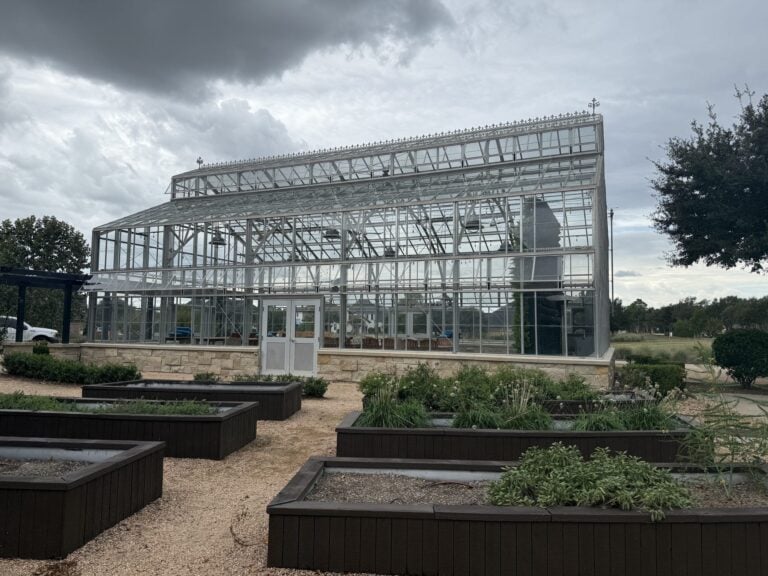
The glass-walled Conservatory at Cane Quarter.
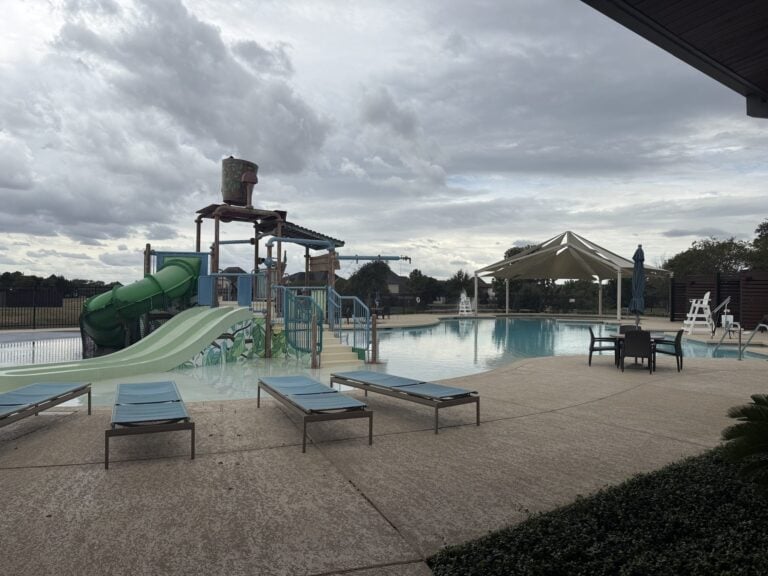
The resort pool and splash area at Cane Quarter.
Out in the sections, the parks add playgrounds, a half-court basketball court, pickleball, shade structures, and little lending libraries. Robertson Elementary sits inside the community at 7400 Innovation Drive.
Cane Island Homes for Sale: the Stock and the Market
The homes are single-family detached, built from 2015 on, on production lots from 45 to 80 feet wide. The median home sold in the past year was built in 2020, ran about 3,030 square feet, and sat on roughly a fifth of an acre, with four bedrooms and three baths as the typical layout. Over the years the builders included Perry Homes, David Weekley, Coventry, Shea, Highland, Chesmar, Toll Brothers, Trendmaker, Taylor Morrison, CalAtlantic, and Partners in Building, along with custom builders. Production building has closed out, and the developer’s builder page now lists only The Estates at Cane Island, a gated section of half-acre-plus custom homesites where William David Custom Homes is building. The developer’s own pages price that product from about $1.5 million to $1.75 million and up.
I pulled the HAR MLS numbers for Cane Island on October 1, 2026, splitting out Lakes of Cane Island so its new construction doesn’t distort the resale picture. Over the previous 12 months, 84 homes closed at a median sale price of $582,450, a median of $188 per square foot, and a median of 40 days on the market. Sales ranged from $350,000 to about $1.99 million, and across the full pull homes closed at a median of 97.9 percent of list price. On October 1, 62 homes were active at a median list price of $562,500, with five more under contract. That works out to roughly 8.9 months of inventory, and anything over about seven months reads to me as a buyer-leaning market. Buyers here currently have room to negotiate on price, repairs, and closing costs, and sellers need to price against the competition from day one.
Builder inventory next door adds to that competition. On the same day, Lakes of Cane Island had 47 active listings, nearly all of them new homes from Perry, Drees, and Chesmar with builder incentives attached. When I price a Cane Island resale, I start from its own section’s closings, separate the larger 70- and 80-foot lots and The Estates from the 45- and 50-foot sections, and keep the Lakes of Cane Island new homes out of the comparables. Those new homes still shape the price, because a buyer will tour them the same weekend.
Featured Cane Island Homes For Sale
 $565,000
Active
$565,000
Active
6714 Pioneer Trail Katy, Texas
3 Beds 3 Baths 2,578 SqFt 0.168 Acres
 $439,000
Active
$439,000
Active
6911 N Elmwood Trail Katy, Texas
4 Beds 3 Baths 2,539 SqFt 0.184 Acres
 $450,000
Active
$450,000
Active
6902 N Elmwood Trail Katy, Texas
4 Beds 4 Baths 2,784 SqFt 0.355 Acres
 $505,000
Active
$505,000
Active
1619 Dove Ridge Drive Katy, Texas
4 Beds 4 Baths 3,290 SqFt 0.169 Acres
 $450,000
Active
$450,000
Active
2419 Elmwood Trail Katy, Texas
4 Beds 3 Baths 2,572 SqFt 0.158 Acres
 $559,990
Active
$559,990
Active
6718 Waxbill Road Katy, Texas
4 Beds 4 Baths 3,072 SqFt 0.211 Acres
See all Cane Island homes for sale →

Scan with your phone camera
What It Costs to Own in Cane Island
Property taxes. Cane Island’s combined rate is $3.037357 per $100 of value, about 3.04 percent, using the 2026 rates on the Waller County Appraisal District’s parcel record. Here is the stack:
| Taxing unit | 2026 rate per $100 |
| Katy ISD | 1.117100 |
| Waller County | 0.535350 |
| Waller County Road & FM | 0.023116 |
| Brookshire-Katy Drainage District | 0.061791 |
| City of Katy | 0.420000 |
| Harris-Waller Counties MUD 3 | 0.880000 |
| Total | 3.037357 |
On a $585,000 home, close to the 12-month median sale, that is about $17,770 a year before exemptions. The state’s school homestead exemption takes $140,000 off the value for the Katy ISD line starting with tax year 2025 ($200,000 for owners 65 or older or disabled), which brings the bill to about $16,200, and the City of Katy’s 20 percent homestead exemption takes off roughly another $490, for about $15,710. My Texas homestead exemption guide shows how the pieces add up. MUD 3 carries bond debt for the water, sewer, drainage, and road system it built, about $136 million as of its November 2024 official statement, and my guide to how MUD districts work in Texas explains where that line comes from.
Expect three tax bills. Waller County homes in Katy ISD have their school tax collected by the Fort Bend County Tax Office, and the City of Katy’s tax is collected there too. Assessments of the Southwest collects the MUD tax, and the Waller County Tax Office collects the county, road, and drainage-district taxes. Lakes of Cane Island, for comparison, runs $3.337357 per $100, because it has no city line but adds Waller-Harris ESD 200 at 0.10 and Waller County MUD 58 at $1.50, a district that has authorized bonds but not yet sold any. Confirm the exact rate and exemptions for a specific address at esearch.waller-cad.org. This is general information, not tax advice.
HOA. The Cane Island Community Association is managed by Inframark, and dues fund Cane Quarter, the lakes, trails, parks, and the events calendar. Current-year dues aren’t published on a primary source; recent listings put them around $1,320 a year, and the gated Estates pay more. The association’s management certificate on file with the state lists a $300 transfer fee, a $1,200 capitalization fee, and a $350 resale certificate at closing, executed in 2021, so the amounts may have moved. The title company orders the resale certificate as part of closing, and that certificate shows the current dues and charges; the contract’s TREC HOA addendum decides who pays each one.
Cane Island Schools
Cane Island is in Katy ISD, rated B (88) by the Texas Education Agency in its 2026 ratings for the 2025–26 school year. I ran Cane Island addresses through Katy ISD’s own address-level assignment data on October 2, 2026, for both the current and the next school year, and they return the same three campuses each year.
| Campus | Grades | 2026 TEA rating | Notes |
| Robertson Elementary | EE–5 | A (92) | 7400 Innovation Drive, inside the community; opened fall 2022 |
| Katy Junior High | 6–8 | A (90) | 5350 Franz Road |
| Katy High School | 9–12 | B (87) | 6331 Highway Boulevard, the district’s original high school |
Lakes of Cane Island shares Robertson Elementary and then splits off: addresses there continue to Haskett Junior High (B, 81) and Freeman High School (A, 91). Katy ISD’s assignment data shows both feeder patterns coming out of the Robertson zone, which is why two homes a short walk apart under the Cane Island name can end up at different high schools.
Zoning is set by the exact property address, and Katy ISD re-zones as new campuses open, so run any specific home through Katy ISD’s Find My School map and read the latest campus ratings at txschools.gov before you rely on any assignment here.
Getting Around & Commute
Cane Island’s access is I-10 through its own Cane Island Parkway interchange, US-90 along the southern edge, the Grand Parkway about five miles east, and FM 1463 by way of the parkway’s south leg. For transit, METRO’s Grand Parkway Park & Ride at 1030 North Grand Parkway runs Route 222 to Downtown on weekdays, and the Kingsland Park & Ride on Kingsland Boulevard runs Route 221; both lots are open to any rider. Cane Island’s far-west position means longer drives to Downtown, the Galleria, and the Medical Center than from the closer-in Katy communities, so the I-10 drive is the one to test before you commit. Confirm current park-and-ride schedules at ridemetro.org.
Flood Risk — What to Check Before You Buy
Cane Island sits in the Cane Island Branch drainage of Buffalo Bayou, west of and upstream from the Addicks and Barker reservoirs. The engineering firm that designed the community, EHRA, describes four drainage systems and 25 detention ponds, and those ponds are the lakes you see throughout the community. That design removed parts of the property from the 100-year floodplain before the homes were built. In 2026 the Brookshire-Katy Drainage District joined Harris and Waller counties on Cypress Creek overflow and Cane Island Branch improvements.
I found no documented record of Cane Island homes flooding, and Harvey’s worst damage in Katy was in other subdivisions. That is an absence of a record, so the lot-level checks still apply. Before an offer, I look up the lot on the FEMA Flood Map Service Center, and during the option period we read the seller’s flood disclosure, ask for any elevation certificate, and get a flood insurance quote so you know what coverage costs for that particular house.
Things to Do Nearby
Inside the community, Cane Quarter carries the load: the resort pool and lap pool, the 24-hour fitness center, the Conservatory, the event lawn, and Texas Borders Bar & Grill, with trails and parks spread across the sections.
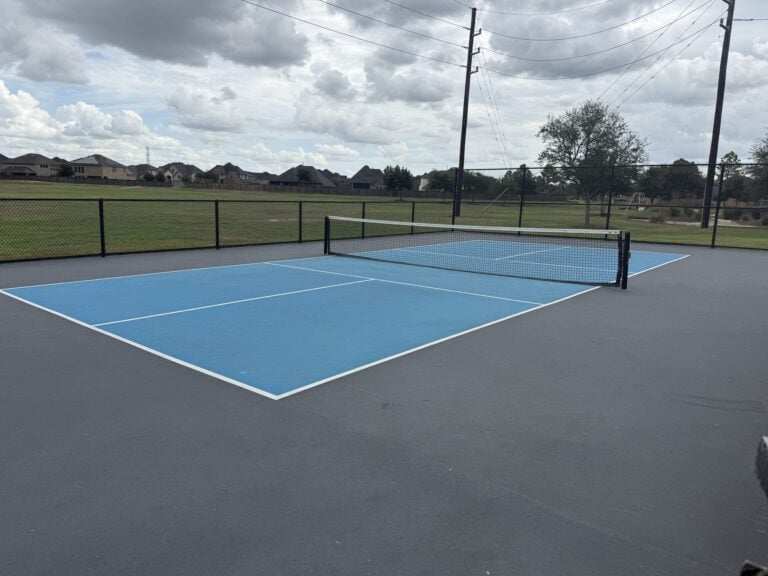
A pickleball court at one of the neighborhood parks.
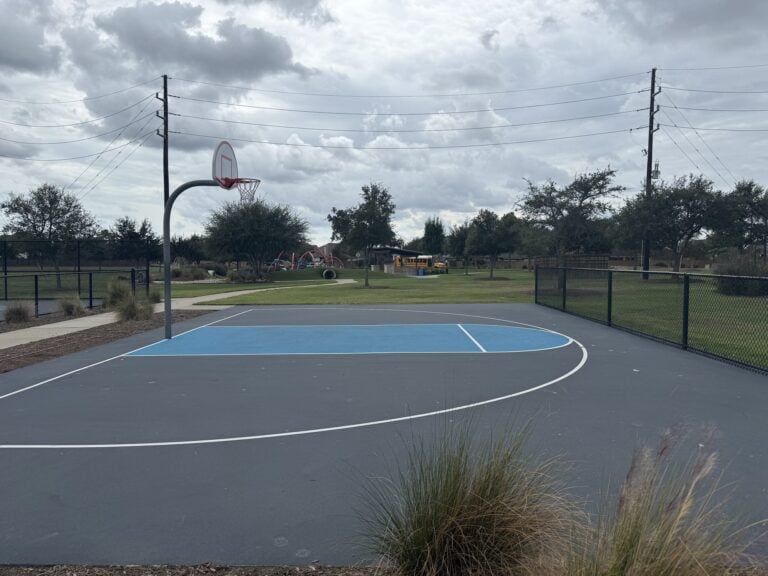
The half-court basketball court at the same park.
Just outside it:
- Parks: Mary Jo Peckham Park, with a stocked fishing lake, a walking trail, and an aquatic center near downtown Katy; Katy Park, the 100-acre youth baseball and soccer complex on Morton Road; and Paul Rushing Park, Katy Prairie land with shallow lakes known for bird-watching, north on Katy Hockley Road.
- Old Town Katy: the restaurants, shops, and Katy Heritage Park in the original town east of the community, the one that started out with the Cane Island name.
- Shopping and errands: Katy Mills and Typhoon Texas at I-10 and Pin Oak, LaCenterra at Cinco Ranch for dining, and Memorial Hermann Katy Hospital on the Katy Freeway.
Is Cane Island the Right Fit?
The case for Cane Island is an established, built-out master-planned community with city services, an A-rated elementary inside the community and an A-rated junior high beyond it, and a complete amenity village with a restaurant you can walk to. Inside the city, the MUD rate is 88 cents, and the city’s 20 percent homestead exemption trims the bill further. With nearly nine months of inventory, a buyer has more negotiating room here today than in Sunterra, which ran about 4.3 months on the same day.
What to plan for: the combined rate of about 3.04 percent is higher than the older Katy communities with paid-down MUDs, and dues and a $1,500-plus capitalization and transfer charge come on top at closing. Cane Island sits farther west than most Katy master plans, so the drive to central Houston is longer. The Lakes of Cane Island build-out continues next door, which means construction traffic along Morton Road for a while and new-home inventory competing with resales. Sections near US-90 and the rail line are worth driving at different times of day before you choose a lot.
If you’re comparing, Sunterra is the newer, lower-priced option with a lagoon and a higher tax stack, Firethorne and Cinco Ranch are established communities with lower combined rates, and Lakes of Katy is the acreage-and-ski-lake end of the north side. Ventana Lakes, north of Clay Road, is a built-out resale community at a lower price point with a combined rate near 2.79 percent. Elyson is the other large north-Katy master plan most buyers tour alongside Cane Island.
Work With a Cane Island Realtor
The first thing I check on any Cane Island listing is the legal description on the Waller CAD record. An MLS search for Cane Island pulls in Lakes of Cane Island as well, and on October 1 that was 47 of the 109 active matches. The two share an elementary school and a name, and almost nothing else: Lakes of Cane Island carries about $1,750 more in yearly tax on a $585,000 home before exemptions, a private water company, a separate HOA without Cane Quarter, and Haskett Junior High and Freeman High instead of Katy Junior High and Katy High. I confirm the plat, the MUD, and the school assignment for the exact address before anyone writes an offer.
The second thing is price. At almost nine months of supply, with builder incentives across the street, a Cane Island resale has to be priced against its own section’s closings and the new homes a buyer will tour the same weekend, and a buyer has room to ask for concessions. I separate the 45- and 50-foot sections from the 70- and 80-foot lots and The Estates, and I watch which listings sit past 40 days. One buyer described how that negotiating work felt from his side: “Kevan negotiated on my behalf, recommended the best areas to purchase a house, and gave me his honest opinion on anything I had a question about. He saved me thousands of dollars.” — Rene C., buyer.
I’m Kevan Pewitt, a REALTOR® and the broker-owner of Houston Prime Realty. My Texas real estate broker’s license dates to 1989, and I carry the Certified Residential Specialist (CRS) designation. Clients have rated me 5.0 across 229 verified post-closing HAR surveys, and Texas Monthly has named me a Five Star Professional for 11 years. Cane Island is part of my work as a Katy REALTOR®, so I can price it against Sunterra, Elyson, and the established communities on the south side of I-10, and against its own comps.
You can reach me directly at 281-500-7077. For sellers, I pull your section’s recent closings and the active builder inventory next door before we talk about price.

Thinking of Selling?
What’s Your Cane Island Home Worth?
Get an instant number from recent MLS closings first. Then I’ll prepare a comparative market analysis from Cane Island’s own resales, adjusted for your section, lot width, lake or greenbelt frontage, and updates, and set against the new-home inventory in Lakes of Cane Island, which is the part an automated estimate can’t see.
What’s My Cane Island Home Worth?
Powered by Houston MLS sales data. No obligation.
Setting Up Utilities in Cane Island
Cane Island is one of the few master-planned communities in the Katy area that sits inside the City of Katy, and that shapes how move-in works. The city runs your water, sewer, and trash, so you’ll open one city utility account instead of juggling a MUD operator and a separate hauler.
Water, sewer, and trash. The neighborhood’s utility district is Harris-Waller Counties MUD 3, and the City of Katy operates the water and sewer system and bills residents directly. You start service with the city’s Utility Billing office (cityofkaty.com); plan on a photo ID, proof of ownership such as the first page of your closing disclosure, and a refundable deposit. Trash and recycling come through the city’s contract hauler, Texas Pride Disposal, and the charge shows up on your water bill. Cane Island’s collection day is Wednesday for garbage, recycling, heavy trash, and yard waste; the city posts the schedule and route maps on its garbage and recycling page.
Electricity (you choose your provider). Cane Island sits in CenterPoint Energy’s service territory on the Public Utility Commission’s map, so it’s part of the deregulated Texas market. You pick your own retail electric provider and can switch at the end of any contract. CenterPoint (centerpointenergy.com) owns the poles, wires, and meter, so that’s who you call about an outage, no matter whose name is on your bill. Shop and sign up at the state’s official marketplace, PowerToChoose.org, and set it up before closing so the power is on in your name the day you get keys.
Natural gas. CenterPoint Energy (centerpointenergy.com) is the gas utility inside Katy city limits. Residential gas is regulated, so there’s nothing to shop; you just open an account. Confirm the house you’re buying has a gas meter.
Internet and TV. Xfinity (xfinity.com) and AT&T (att.com) serve the Katy area, and Consolidated Communications (consolidated.com) offers fiber in parts of town. T-Mobile and Verizon 5G home internet and satellite service (Starlink, Viasat, HughesNet) are also options. Fiber can change from one street to the next, so check the exact address on the FCC National Broadband Map (broadbandmap.fcc.gov) before you count on it.
HOA. The community is governed by the Cane Island Community Association, managed by Inframark (inframark.com). Owners use the association’s resident portal, caneisland.nabrnetwork.com, for documents, account details, and access to Cane Quarter’s pools, fitness center, and event spaces. Your resale certificate at closing shows the current dues, and the association’s management certificate on file with the state lists the transfer and capitalization fees collected at closing (hoa.texas.gov).
After you close. File your homestead exemption with the Waller County Appraisal District (waller-cad.org). It’s free, and you never need to pay a third party to do it. Expect three property-tax bills: the Fort Bend County Tax Office (fortbendcountytx.gov) collects the Katy ISD and City of Katy taxes on Waller County homes; Assessments of the Southwest (aswtax.com) collects the MUD tax; and the Waller County Tax Office (tax.co.waller.tx.us) collects the county, road, and drainage-district taxes. Police, fire, and EMS come from the City of Katy (cityofkaty.com).
Lakes of Cane Island is set up differently. The newer development next door is unincorporated, gets water from a private utility rather than the city, contracts its own trash service, and has its own HOA. If you’re looking there, the details above don’t carry over.
Providers, districts, and coverage vary by address and change over time — verify for your specific home before relying on any of the above. Verified October 1, 2026. Not legal or tax advice.
Quick Answers
Is Cane Island the same as Lakes of Cane Island?
No. Lakes of Cane Island is a separate 221.5-acre, 570-lot development across Morton Road to the north, running up toward Clay Road. It is outside the City of Katy, pays Waller County MUD 58 at $1.50 per $100 and Waller-Harris ESD 200 for a combined 2026 rate of about 3.34 percent, gets water from a private utility, and has its own HOA without access to Cane Quarter. Its homes continue from Robertson Elementary to Haskett Junior High and Freeman High. Check the legal description on the Waller CAD record for any listing marked Cane Island.
Is Cane Island inside the City of Katy?
Yes. The City of Katy annexed Cane Island in two steps, about 597 acres in November 2013 and about 400 acres in April 2015, and Harris-Waller Counties MUD 3 lies entirely within the city limits. The city provides water, sewer, trash, police, and fire, and its 0.42 tax rate appears on the bill alongside the 0.88 MUD rate. Homesteads also get the city’s 20 percent homestead exemption. Confirm a specific parcel’s taxing units at esearch.waller-cad.org.
What schools serve Cane Island?
Cane Island is in Katy ISD (TEA 2026 B, 88). Katy ISD’s address-level assignments for 2025–26 and 2026–27 send Cane Island homes to Robertson Elementary (A, 92), inside the community, then Katy Junior High (A, 90) and Katy High School (B, 87). Lakes of Cane Island, next door, shares Robertson and then goes to Haskett Junior High and Freeman High. Verify the exact address on Katy ISD’s Find My School map.
What are the property taxes in Cane Island?
The 2026 combined rate on the Waller CAD roll is $3.037357 per $100, about 3.04 percent: Katy ISD 1.1171, Waller County 0.5354, Road and FM 0.0231, Brookshire-Katy Drainage 0.0618, City of Katy 0.42, and MUD 3 0.88. On a $585,000 home that is about $17,770 before exemptions, about $16,200 with the $140,000 school homestead exemption, and about $15,710 with the city’s 20 percent homestead exemption as well. Confirm per address at esearch.waller-cad.org.
Are Cane Island property taxes higher than the rest of Katy?
It is higher than the established communities and lower than the newest ones. At about 3.04 percent, Cane Island runs above established Katy master plans with paid-down MUDs, such as Firethorne at about 2.32 percent, a gap of roughly $4,200 a year on a $585,000 home before exemptions. It runs below Sunterra at about 3.28 to 3.35 percent and Lakes of Cane Island at about 3.34 percent. The city and MUD lines together come to $1.30 per $100, less than the $1.50 MUD rate in many newer communities, and the city’s homestead exemption helps further. Check the parcel at esearch.waller-cad.org.
What’s the typical home price in Cane Island?
Over the 12 months ending October 1, 2026, 84 Cane Island homes sold at a median of $582,450, or about $188 per square foot, per HAR MLS, with sales from $350,000 to about $1.99 million and a median of 40 days on the market. On October 1, 62 homes were active at a median list price of $562,500, which is about 8.9 months of inventory and a buyer-leaning market. Those figures exclude Lakes of Cane Island. Ask for a section-level pull before you price a specific home.
What are the Cane Island HOA dues and closing fees?
The Cane Island Community Association is managed by Inframark. Current dues are reported around $1,320 a year in secondary sources, and the gated Estates pay more. The management certificate on file with the state lists a $300 transfer fee, a $1,200 capitalization fee, and a $350 resale certificate at closing, filed in 2021. The title company orders the resale certificate as part of closing, and it shows the current amounts; the contract decides who pays each one. Verify the figures on the resale certificate for the specific home.
Is Cane Island in a flood zone?
It varies by lot. Cane Island sits in the Cane Island Branch watershed, west of and upstream from the Addicks and Barker reservoirs, and its drainage was designed around four systems and 25 detention ponds that double as the community’s lakes. No documented record of Cane Island homes flooding was found, which is not a guarantee. Check the exact address at the FEMA Flood Map Service Center, read the seller’s flood disclosure, and request any elevation certificate.
Is Cane Island still building new homes?
Inside Cane Island, production building has finished, and the market is mostly resale; custom homesites remain in The Estates at Cane Island, a gated half-acre-plus section where William David Custom Homes is building, priced by the developer from about $1.5 million. Active production building under the Cane Island name is in Lakes of Cane Island next door, with Perry Homes, Drees Custom Homes, and Chesmar Homes. If you tour a model there, have your real estate agent register you on the first visit. Confirm the plat for any new home you are shown.
Who is a good real estate agent for Cane Island?
Look for someone who confirms the plat, the MUD, and the school assignment for the exact address, because the MLS mixes Cane Island and Lakes of Cane Island, and who prices a resale against its own section’s closings and the builder inventory next door. Ask a candidate how Cane Island’s taxes and schools differ from Lakes of Cane Island; the answer will tell you quickly whether they have worked here. I’m Kevan Pewitt, a REALTOR® and the broker-owner of Houston Prime Realty, a Texas real estate broker since 1989, with a 5.0 average across 229 verified HAR client reviews. My guide on how to choose a Realtor lists the questions to ask any real estate agent, and my post on how real estate buyer’s agents get paid in Texas lays out the options. Call or text 281-500-7077.
Questions About Cane Island? Send Me a Note
Curious about a specific section, which plat a listing sits on, how a resale compares with the new homes next door, or what the yearly cost looks like once the taxes, dues, and insurance are in? Send me a note and I’ll answer it myself.
Let’s Find Your Place in Cane Island
Call or text me at 281-500-7077 or email kevan@houstonprimerealty.com, and I’ll go over what’s for sale by section and lot width, which plat each home sits on, and what the real yearly cost looks like. — Kevan Pewitt, REALTOR® and Broker, Houston Prime Realty